Doctors Support AI in Healthcare - But Not Chatbots
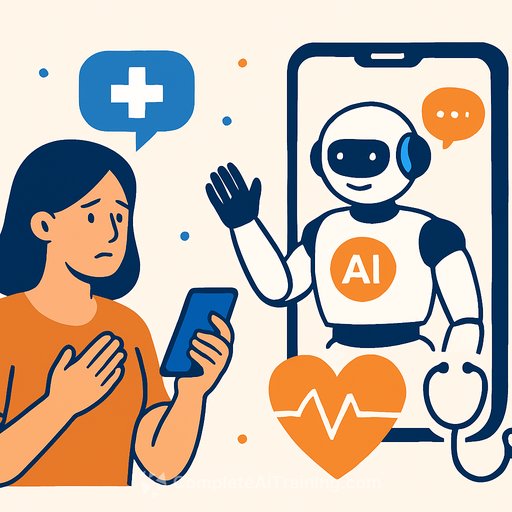
Health systems are testing AI hard, but most clinicians agree: keep it behind the scenes. The upside shows up in workflow, not bedside banter. Tools that draft notes, prep prior auths, and surface chart insights are earning trust. Open-ended chatbots that sound confident while being wrong are not.
Chatbots Meet Clinical Reality
Large language models still hallucinate. That might be fine for trivia, but it's risky for clinical guidance. Independent benchmarking efforts continue to show errors on open-ended medical questions without tight guardrails.
Even when a chatbot gets it right, it usually lacks the context that matters: longitudinal history, meds, allergies, local protocols, social risk-everything that makes recommendations safe. Privacy is another concern. Connecting wearables, pharmacy feeds, and EHR data to a general-purpose bot raises questions about data use, auditability, and whether HIPAA obligations actually apply.
Regulators are pushing for transparency inside certified health IT. The ONC's HTI-1 rule calls for algorithmic transparency, and NIST's AI Risk Management Framework outlines practices for safety and bias. Consumer chatbots often sit outside those rails. Teams responsible for compliance and oversight can consult the AI Learning Path for Regulatory Affairs Specialists for practical guidance on governance and policy automation.
Provider-Side AI Is the Fast Lane
Clinicians spend roughly half their time on EHR work and desk tasks. That's capacity locked away from patients. AI that summarizes charts, drafts notes, creates discharge instructions, and assembles prior auth packets can reclaim hours per week-under human review.
Health systems are reporting fewer after-hours clicks and faster pre-visit prep. Given burnout levels that surged above 60% in recent years, even a 20-30% time win changes access, morale, and continuity of care.
Examples Taking Root
- Ambient documentation: Tools listen to the visit and draft structured notes for clinician review. Early evaluations at large systems (e.g., Cleveland Clinic, UPMC) report meaningful drops in documentation time.
- EHR summarization: Epic and Oracle Health are rolling out features that surface relevant labs, consults, and imaging to speed chart review.
- Context-aware EHR queries: Academic centers are testing interfaces where clinicians ask, "Show renal function trends since the ACE inhibitor dose change," and get sourced answers from the chart.
- Payer automation: Insurers and TPAs use AI to pre-fill prior auths and verify necessity against policy criteria, reducing back-and-forth that delays care.
Guardrails Clinicians Want
- Provenance: Every assertion is sourced and traceable-citations, timestamps, and links to the chart.
- Retrieval over recall: Pull from trusted, up-to-date sources and the local EHR, not generic web training.
- Security: Strict access controls, audit trails, and clear data retention policies. Leaders responsible for IT strategy can find governance and security approaches in the AI Learning Path for CIOs.
- Bias testing: Evaluate performance across race, language, sex, age, and socioeconomic groups; report gaps and mitigation plans.
- Human-in-the-loop: Nothing writes to the chart or triggers patient outreach without clinician review.
- Clinical oversight: If a tool nudges diagnosis or treatment, follow FDA guidance for clinical decision support and software as a medical device, with validation and postmarket monitoring.
Equity should be non-negotiable. For triage or navigation, limited-scope agents tied to health-system playbooks and local resources beat open-ended chat. Patients get routed faster and more safely.
What Patients Can Expect Right Now
Consumer chatbots can still help with low-risk tasks: translating after-visit summaries, drafting question lists for appointments, and organizing home monitoring data. Patients should favor tools that cite sources, disclose data use, and allow exports.
They should avoid uploading sensitive information unless the service clearly operates under a HIPAA-compliant business associate agreement with their provider. Clear labeling and consent matter.
Practical Next Steps for Health Leaders
- Pick a bottleneck: Start with documentation, pre-visit review, prior auth, or inbox triage. Limit scope and define exclusions.
- Set strict success metrics: Minutes saved per encounter, after-hours EHR time, turnaround time, safety events, and patient access (wait times, panel size).
- Build governance: Multidisciplinary review (clinical, informatics, compliance, equity, security), change control, and a rollback plan.
- Pilot with champions: Small cohort, rapid feedback cycles, shadow mode first, then supervised write-back.
- Monitor continuously: Drift checks, bias audits, error sampling, and post-deployment training refreshers.
- Communicate clearly: Tell clinicians what the tool can and can't do, and make reporting issues simple.
The near-term win isn't flashy. If AI quietly gives back 20-30% of a clinician's day and shortens the path from referral to treatment, patients feel it fast. Less time clicking. More time caring.
Want structured training for teams adopting AI in clinical operations and admin workflows? Explore role-based options at AI Learning Path for Project Managers.
Your membership also unlocks: