Akara brings order to the operating room with AI and thermal sensors
Surgeries run on precision. The schedules around them don't. Hospitals lose hours each day to manual planning, unclear handoffs, and waiting for the room to be ready for the next case.
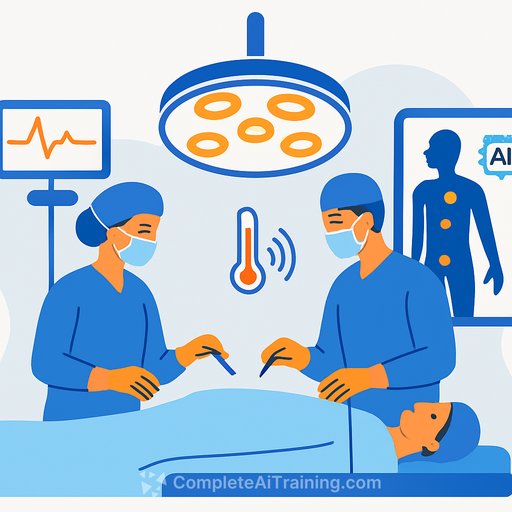
Akara, led by co-founder and CEO Conor McGinn, is attacking that gap with a system that watches operating rooms using thermal sensors and AI. Think of it as a control tower for OR flow-clean, privacy-safe signals in, clear decisions out.
What Akara is building
The team moved away from a focus on cleaning robots and leaned into ambient sensing. Why? Because the main constraint isn't equipment; it's coordination. Rooms sit idle while teams wait for confirmation: Is the prior case closed? Has turnover actually started? Is the air exchange complete?
Akara's platform turns those unknowns into timestamps. That lets operations leaders plan accurately, reduce downtime, and bring rooms back online faster.
How thermal sensing protects privacy while tracking progress
- No identifying detail: Thermal sensors capture heat signatures and activity patterns, not faces or patient data.
- Action-focused: Detects phases like incision start, closure, cleaning start/end, door activity, and turnover completion.
- Signal to schedule: The system translates real-time events into predictable timelines for the next case.
This approach fits strict privacy requirements and avoids adding more screens or manual logging for the team. For context on privacy rules in healthcare, see HIPAA guidance.
The real bottleneck is infrastructure, not the robot
Hospitals have advanced tools in the room. The friction sits in everything around the room-sterile flow, EVS timing, transport, case cart readiness, room turnover, and communication across shifts.
Akara's promise is simple: show what's actually happening, in real time, so teams can act sooner with fewer handoffs and less guesswork.
Why this matters to Operations
- Stabilize the schedule: Fewer delays, fewer late starts, fewer cancellations.
- Shorter turnovers: Clear signals trigger EVS and prep at the right moment.
- Higher OR utilization: Better room readiness means more cases without adding rooms or staff.
- Lower overtime and agency spend: Predictable days reduce spillover and burnout.
- Staff retention: With up to 40% of medical staff projected to leave within five years, reducing friction matters.
For practical guidance on applying AI to hospital workflows and scheduling, see AI for Operations.
Implementation playbook (start small, scale fast)
- Pick a pilot: 1-2 rooms with frequent turnovers and mixed case types.
- Map the workflow: OR, EVS, sterile processing, transport, and scheduling on one page.
- Integrate lightly: Start with event feeds and dashboards; add EHR/OR scheduling integration later.
- Set alert rules: Define who gets notified at each event (cleaning start, air exchange complete, ready-for-patient).
- Measure weekly: Turnover time, on-time starts, delays >15 minutes, cancellations, overtime hours.
- Lock SOPs: Convert successful patterns into standard work before expanding to more rooms.
What to ask any vendor in this space
- Sensing and coverage: How many sensors per room? Any blind spots? How are door events handled?
- Accuracy and drift: How is performance validated over time? What's the plan for recalibration?
- Integration: Which OR scheduling/EHR systems are supported? What's the minimum viable integration?
- Alert fatigue: How are thresholds tuned? Can teams snooze or route alerts by role and shift?
- Security: Data stored on-prem or cloud? Retention policy? Access controls and audit trails?
- Proof and ROI: Results from NHS checks or pilots? Reference sites? Time to value for turnover and on-time starts?
- Resilience: What happens during network outages? How is data buffered and recovered?
Why NHS validation matters for U.S. hospitals
Scrutiny from national health systems sets a high bar for safety and reliability. Passing those checks gives operations teams more confidence in deployment and change management.
For background on the conversation that put this topic on the map, see the TechCrunch Equity coverage of Akara.
What success looks like in 90 days
- Consistent turnover time reduction on pilot rooms.
- On-time starts trending up with fewer late-day slips.
- Cleaner handoffs between OR, EVS, and sterile processing.
- Fewer last-minute cancellations tied to room readiness.
- Documented SOPs and a plan to extend to additional rooms.
Bottom line for hospital operations
If you remove uncertainty from the operating room, everything downstream gets easier. Thermal sensors plus AI don't replace teams-they give them clean signals to move sooner and waste less time between cases.
Start with one problem room. Prove it. Then roll across the board.
Level up your team's AI skills
If you're building internal capability to run AI-enabled operations, explore practical training for ops roles here:
Your membership also unlocks: