Letting AI agents interrupt made them better at complex reasoning
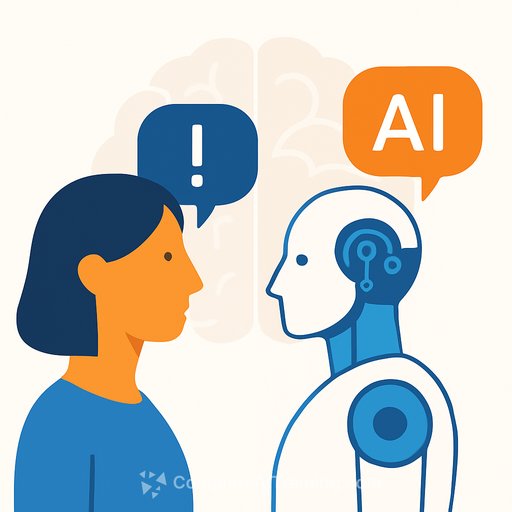
Give AI the ability to interrupt, pause, or stay quiet, and it thinks more clearly. That's the core finding from a new study that pushed large language model (LLM) agents to act more like people in live conversation. The result: more accurate conclusions on hard problems.
Instead of strict turn-taking, agents were given personality-driven behaviors and a real-time "urgency" trigger to cut in when it mattered. That small shift in dynamics had a big impact on debate quality and final answers.
What changed
Traditional chatbots wait, respond, and wait again. This framework let agents speak out of turn, hold back if they had nothing useful to add, or push a point the moment it became critical. Personality traits from the Big Five shaped how assertive, agreeable, or talkative each agent was.
Crucially, responses were processed sentence by sentence rather than as a single block. That streaming setup allowed the system to manage the flow in real time and decide whether to interrupt or stay silent.
How the system worked
- Personality modeling: Agents were assigned traits along openness, conscientiousness, extraversion, agreeableness, and neuroticism to vary style and initiative.
- Turn-taking modes: Fixed order, dynamic order, and dynamic with interruption enabled.
- Urgency score: A live signal that rose on detected errors or pivotal points. High urgency triggered immediate interjection; low urgency kept the channel clear.
- Sentence-level streaming: Incremental generation let agents monitor and react mid-thought rather than waiting for full outputs.
Measured gains on hard tasks
The team tested 1,000 questions from the Massive Multitask Language Understanding benchmark.
- If one agent started wrong: accuracy rose from 68.7% (fixed order) to 73.8% (dynamic order) to 79.2% (interruptions allowed).
- If two agents started wrong: accuracy rose from 37.2% to 43.7% to 49.5% with interruptions enabled.
Translation: real-time debate with smart interruptions helped the group course-correct faster and land on better answers.
Reference: MMLU benchmark (arXiv)
Why this matters for research teams
Most multi-agent systems feel clean on paper and messy in practice. This work embraces the mess to get better outcomes. If your team runs agentic literature reviews, code audits, or analysis sprints, controlled "rudeness" can surface critical corrections sooner and cut filler talk.
Practical playbook to try this yourself
- Define roles and personalities: Mix agents with different Big Five profiles to diversify approaches and confidence levels. See APA: Big Five factors.
- Use streaming generation: Process outputs sentence by sentence so other agents can monitor and interject in real time.
- Implement an urgency score: Trigger interrupts on contradictions, factual errors, math/logic slips, or high-impact decisions. Keep a low-urgency path for staying silent.
- Set turn-taking policies: Allow limited "raise-hand" interrupts with cooldowns to prevent chaos.
- Reward precision: Score interjections by usefulness and penalize noise. Silence is a valid action.
- Evaluate like a scientist: Benchmark on your domain tasks (e.g., datasets, codebases, protocols) before deployment.
Guardrails so "rude" stays useful
- Rate-limit interruptions and cap simultaneous speakers.
- Require brief justifications for high-urgency cuts ("conflict with prior result X").
- Rotate speaking priorities to avoid dominance by one assertive agent.
- Filter for toxicity; assertive does not mean abrasive or biased.
- Log all turns and urgency changes for audit and error analysis.
- Keep a human-in-the-loop for high-stakes calls.
Where this heads next
The researchers plan to apply personality-shaped, interruptible agents to creative and collaborative work. That's where the mix of initiative, silence, and timing can move a group from consensus theater to real progress.
Want to explore related builds and deployments? See AI Agents & Automation and Generative AI and LLM.
Bottom line
Strict politeness slows correction. Give agents permission to interrupt with purpose, stay quiet on low value, and speak in real time. You'll get fewer words, more signal, and better answers on hard problems.
Your membership also unlocks: