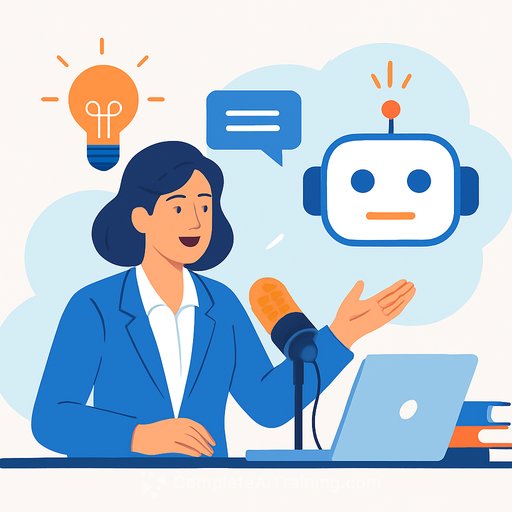
ASD superintendent launches podcast; first episode explores AI in education
Allentown School District Superintendent Carol Birks launched a new quarterly podcast on Thursday, Dec. 11, 2025, and started with the topic everyone in K-12 is talking about: artificial intelligence.
"I'm really proud of the ways we have been implementing AI throughout the district," Birks said on the inaugural episode of "Lighting the Way with Dr. Carol D. Birks," a nod to ASD's strategic plan, "Lighting the Way: A Blueprint for Innovation and Excellence 2030."
Student voice: Bridgeview Academy's model in action
ASD senior Jayden Santos from Bridgeview Academy shared how a theme-based high school can make AI practical. The school offers career pathways in AI, computer science, and health care, and recently opened a media lab with a full production studio.
Santos used the studio to produce a public service announcement on gun violence for his government class. "It was so much more engaging than just writing a paper," he said.
Bridgeview participates in the Verizon Innovative Learning Schools (VILS) program, which provides students with iPads, keyboards, and 24/7 internet access. Tech team students like Santos receive advanced training and will help teachers and peers use tools in the new makerspace, including 3D printers. Learn more about VILS at Digital Promise.
The school will also pilot lessons on digital identity and responsible AI use. "AI has gone from the thing that we don't talk about in classes or in schools to being something that we use in many of our classes," Santos said.
How teachers are using AI - and teaching ethics
English teacher Charles Schmied built a classroom behavior app that runs during class to help students self-monitor. Families can review reports, which gives everyone a clear view of patterns and progress.
Schmied also created an AI-supported reading tool that helps students annotate texts. The goal: keep students doing the thinking while removing friction that slows down comprehension and discussion.
Ethics are part of the routine. When U.S. government teacher Shannon Salter found students using AI to write conclusions, she didn't just penalize them. She compared AI-written work to student-written work and showed the difference in quality. "Instead of giving them zeros and not accepting the work, Ms. Salter showed us how AI didn't actually do a good job at replacing us," Santos said.
Risks and workforce impact
Brennan Pursell, a DeSales University business professor and director of the Center for Data Analytics and Applied AI, discussed both opportunity and risk. He estimated that about 80% of jobs will be affected by AI in some way, with changes across accounting, marketing, and operations - while many trades that rely on manual labor may see less impact.
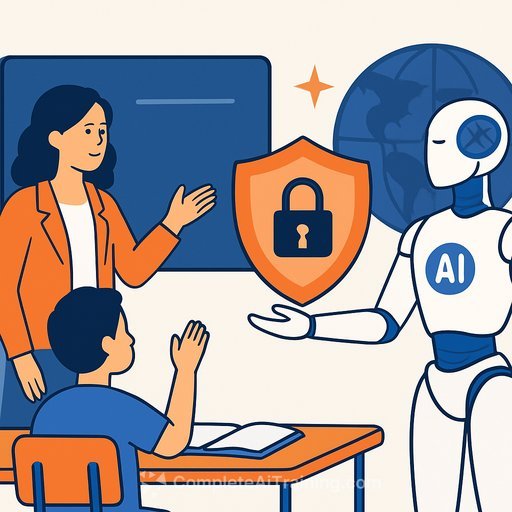
Pursell also warned that AI can be toxic or addictive, especially for children and people with mental health challenges. He urged schools to teach with clarity and set strong guardrails. "I don't demonize it, but we have to identify the risks."
On policy, State Sen. Nick Miller co-sponsored a bill focused on AI safety and disclosures to protect children and those at risk of self-harm. Meanwhile, President Donald Trump signed an executive order to block states from regulating AI, favoring a national approach - a move tech experts expect to be challenged in court, according to NPR's reporting.
ASD's toolset: safety first
Kyle Kauffman, ASD's director of innovation and instructional technology, said the district chose AI tools with student safety as a top priority. The district uses Google Gemini's guided learning features to prompt students with questions and keep them exploring with structure.
ASD also uses Google Notebook LM as a research companion, plus creation tools like Canva and Adobe Express. Tool selection varies by grade: ALEKS supports personalized math in secondary, and Coursemojo serves as an assistant teacher in sixth-grade English for differentiated instruction and instant feedback.
"The reason we chose it partially is because it's built with safety in mind, it's built with education in mind," Kauffman said. "We're very serious about our chatbots and our models that we're using."
What school leaders can do next
- Set clear use cases: research support, drafting, feedback, and differentiation. Keep original thinking with the student.
- Adopt safe-by-design tools with admin controls, age-appropriate experiences, and audit trails.
- Teach the line: when AI assists vs. when it replaces student work. Share side-by-side comparisons.
- Stand up a student tech team to train peers and staff; pair it with a makerspace for hands-on problem solving.
- Sequence tools by grade level and subject; start where feedback loops are tight (writing, reading, math practice).
- Include digital identity and AI literacy in advisory or core classes; communicate norms to families.
- Monitor wellness: teach students how to spot bias, hallucinations, and manipulative chatbot behavior.
- Invest in teacher time: micro-PD, planning templates, and shared prompts tied to curriculum goals.
Why this matters for education jobs
AI is changing how work gets done - from analysis to communication. Schools that teach students to think with AI, not outsource thinking to it, will graduate more capable problem solvers. That starts with safe tools, explicit norms, and teachers who model effective use.
Resources for your team
- Program model: Verizon Innovative Learning Schools (Digital Promise)
- Curated learning for staff: AI courses by job role at Complete AI Training
What's next
The next episode of "Lighting the Way with Dr. Carol D. Birks" has not yet been announced. Expect continued focus on practical classroom use, safety, and workforce readiness - the areas where districts can make real progress fast.
Your membership also unlocks: