Generative AI Research: Used Well, LLMs Can Unlock More Creative Ideas
Generative AI isn't just about speed. It changes how we think during the messy front end of creativity-the part where you explore, break assumptions, and find angles no one else sees.
Corporate adoption reflects that shift. In a 2025 survey, "idea generation and brainstorming" posted the largest jump year over year (+12%) and entered the top five most common use cases. The question for creatives: Are we getting more of the same ideas-just faster-or genuinely fresher thinking?
What Makes an Idea Good?
Strong ideas are original and appropriate. Originality = how far an idea departs from the obvious. Appropriateness = whether it's feasible and useful in context.
Quantity matters because it increases your odds. You cast a wide net, filter hard, and keep the few that score high on both originality and fit. The catch: if everyone uses the same tools the same way, the output can converge.
Two Engines of Creativity: Persistence and Flexibility
Creativity runs on two engines:
- Persistence: push deeper on a narrow path; generate many versions of a promising direction.
- Flexibility: connect distant concepts; jump across categories to find surprising combinations.
LLMs are good at both-endless output (persistence) and broad concept remixing (flexibility). But they're trained on what's common, so you need to push them off the beaten path.
Make LLMs Productive: Focus + Technique
Use AI to grind through volume without losing relevance. Keep the brief sharp and layer context.
- Fine-tuning: train on brand guidelines, past winners, and customer voice to keep ideas on-brief.
- Few-shot prompting: show 3-5 great examples so the model understands tone, format, and constraints.
- Retrieval-augmented generation (RAG): let the model pull from fresh Research, reviews, and market data so ideas fit real behavior and timing.
Expand Semantic Range: Tactics to Push Beyond Clichés
Ask for unusual connections and structure the thinking. Toggle between "go wild" and "tighten up."
- Persona modifiers: "Propose launch concepts as a blunt creative director, a skeptical CFO, and a Gen Z shopper." Compare and combine.
- Hybrid prompting: split the brief into varied sub-prompts (audiences, metaphors, constraints), then recombine the best fragments.
- Chain-of-thought: force steps: "brainstorm → reframe → exaggerate → simplify → write the one-line pitch."
- Temperature settings: higher = more surprising, but messier. Use high for raw ideation, low for refinement. See a short primer on temperature in the OpenAI docs.
Practical Roles LLMs Can Play
LLM as Lead Ideator
- The Designer: generate dozens of variants (taglines, hooks, layouts), control variables for A/B tests, and surface hidden biases in your messaging; partner with Design-centric workflows to explore visual directions.
- The Writer: tighten the pitch, clarify value, craft angle lines, and frame ideas so they land with stakeholders and clients.
LLM as Thought Partner
- The Interviewer: run a Socratic session that challenges assumptions, asks "where's the proof," and teases out blind spots.
- The Actor: role-play customers or subcultures to stress-test tone, objections, and desirability. Note: online voices can skew these personas-treat as directional, not definitive.
A Simple Co-Ideation Sprint for Creatives
- 01. Define the edge: write a 3-sentence brief with goal, constraints, and success signals.
- 02. Go wide: high temperature, multiple personas, hybrid prompts. Aim for 100 raw ideas.
- 03. Cull hard: score for originality and fit. Keep the top 10.
- 04. Go deep: low temperature. Generate 10 variations per idea (format, tone, audience).
- 05. Stress-test: use Interviewer and Actor modes to poke holes. Fix weak spots.
- 06. Commit to 3: write one-sentence bets and a 5-bullet plan for each. Move to small tests.
Avoid Sameness and Scoring Traps
- Diversify prompts: run multiple creative "lenses" (e.g., surrealism, frugality, accessibility, cultural remix) on the same brief.
- Team prompts: have each teammate write their own seed examples to avoid one shared style dominating.
- Masked briefs: test ideas without brand context first, then re-introduce constraints. This rescues bold outliers that would've been filtered too early.
- Don't over-trust early AI scoring: predictive filters lean safe. Keep a wild-card slot in every review.
- Ship small tests: let real behavior, not just model predictions, decide what sticks.
Where LLMs Help Most (Right Now)
- Volume and variants: generating many tight options for copy, hooks, and visual directions.
- Clarity and framing: making ideas easier to buy, sell, and remember.
- Context remixing: connecting distant references you might not reach in one session.
Bold leaps still lean human. Use AI to widen the field and polish the pitch; rely on your taste, instincts, and lived context to pick bets and push for weird-in a good way.
If You Want to Level Up Your Prompt Craft
- Prompt Engineering playbooks for creative teams
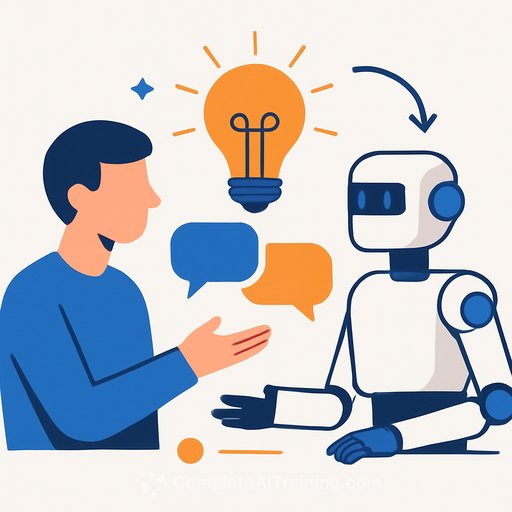
Bottom line: Treat the model like a versatile creative partner. Use it to scale volume, stretch thinking, and adopt the right role at the right moment-designer, writer, interviewer, actor. Keep your process deliberate, protect originality, and let the best ideas prove themselves in the wild.
Your membership also unlocks: