AI agents enter reinsurance broking workflows at Lockton Re
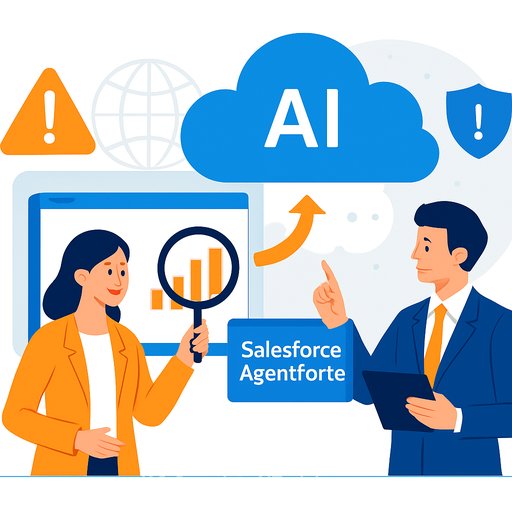
Lockton Re has deployed Salesforce's Agentforce 360 Platform across its global Salesforce environment, bringing autonomous AI agents into live broking and sales workflows. These agents work within Financial Services Cloud using non-personal enterprise data to analyze information, make decisions, and execute tasks under Lockton Re's policies and controls.
The goal is practical: sharper account insight, fewer manual steps, and more consistent follow-through across global teams. Early rollout follows a proof-of-concept with a smaller user group.
How it works inside Salesforce
Agentforce connects directly to Lockton Re's data models, workflows, and governance in Financial Services Cloud. That means agents can triage producer accounts, surface risks and opportunities, and trigger next best actions without leaving the firm's system of record.
It's a shift from standalone analytics to operational AI. Lockton Re already built AI-driven tools in its analytics platform, Lockton Re SAGE. Now, the agents act in-system, where producers and brokers spend their day.
What this means for broking and sales
- Automated account reviews: flag gaps, renewals at risk, and white space by line, region, and carrier.
- Action prompts: prioritize outreach, meeting prep, and documentation tied to pipeline health.
- Consistency: apply internal policies the same way across teams and markets.
- Global coordination: make it easier for distributed teams to share context and avoid duplicate effort.
Leadership framed the move as augmentation, not replacement. Robert Bisset, CEO for North America, said the rollout will streamline select sales activity and help create better informed, more digitally connected broking teams. He underscored the firm's "born digital" pillar since 2019 and the ongoing push to use AI to support clients, partners, and colleagues.
Nidhi Howell, head of business technology at Lockton Re International, reinforced that view: AI should extend employees' expertise, not displace it. The Agentforce rollout fits a broader strategy to integrate or build the right tools to deliver value and improve client service.
Salesforce Agentforce provides the agent layer, but the lift comes from data quality, role-based access, and clear guardrails inside Financial Services Cloud.
Operational AI brings new risk questions
Lockton Re, working with Lockton International and Armilla AI, examined how AI-driven systems interact with insurance frameworks. The takeaway: AI's probabilistic behavior can create loss scenarios that don't cleanly trigger traditional cyber or liability coverage.
The research highlights potential financial exposure from AI-related failures that fall between existing policy constructs. Supporting the trendline, researchers at George Washington University have tracked 150+ U.S. lawsuits in the past five years tied to incidents involving AI systems.
Practical checklist for insurers, reinsurers, and brokers
- Define permissible data: clarify what enterprise data agents can access, write to, or trigger.
- Set agent guardrails: role-based access, human-in-the-loop approvals for high-impact actions, and clear escalation paths.
- Scenario test for variance: run failure modes (hallucination, misclassification, stale data) and document controls and recoveries.
- Refresh underwriting questions: capture insureds' AI usage, model classes, third-party dependencies, and control maturity.
- Assess coverage gaps: map AI failure scenarios to policy language; consider endorsements for model error, model drift, and data contamination.
- Instrument audit trails: log prompts, outputs, decisions, and overrides for claims investigation and regulatory inquiries.
- Adopt a risk framework: align model governance to an established standard such as the NIST AI Risk Management Framework.
- Train front-line teams: give producers, brokers, and claims handlers playbooks for when to trust, verify, or shut off an agent.
What to watch next
Expect early wins in pipeline hygiene, renewal prep, and cross-sell identification. The long-term impact depends on data stewardship, clear ownership of agent actions, and measurable KPIs such as cycle time, hit ratios, and service levels.
For carriers and reinsurers, the underwriting signal is shifting. Exposure now includes how an insured builds, buys, and governs AI-across both technology and process. Policies, endorsements, and claims protocols will need to keep pace.
For deeper industry use cases and risk frameworks, explore AI for Insurance.
Your membership also unlocks: