
AI news ·
London musician with Parkinson's uses AI tools to finish album after losing ability to play guitar
Samuel Smith, a singer-songwriter with Parkinson's, used AI music tools to create demos for his new album after the disease left him unable to play guitar. The AI didn't write his songs-it helped him show session musicians what he heard in his head.
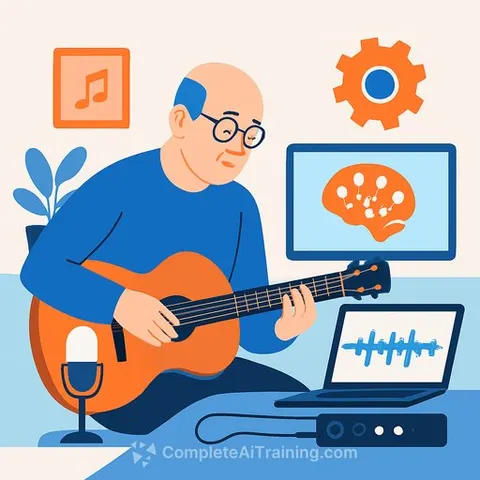
Musician with Parkinson's Uses AI to Finish Album When His Hands Failed
Samuel Smith spent decades writing Americana songs with a guitar. Parkinson's disease took that away. Now the London-based singer-songwriter is using AI music generators to continue making music after his diagnosis in 2020 left him unable to play.
Smith released his second album, "The Art of Letting Go," this year. For one instrumental track called "Horizon," he used AI platforms Suno and Udio to create demo arrangements. He hummed rough melodies into his phone, uploaded them to the generators, and added prompts describing instrumentation and mood.
The tremors, stiffness and fatigue from Parkinson's steadily eroded his guitar skills during the year-plus he worked on the album. "Don't play, don't be creative, or find a way out, find a route," the 49-year-old said. "And for me, this was the route."
How He Used the Tools
Smith emphasized the AI demos were never mixed into the final recordings. Instead, they served a single purpose: communicating his artistic vision to session musicians.
Producing convincing demos required "50, 100, 150 attempts" and extensive editing, he said. "AI is not replacing anything for me," Smith said. "It's unlocking, it's enabling. It's allowing me to keep writing. I upload my lyrics; AI doesn't create my lyrics."
The album features Grammy-winning musicians including dobro player Jerry Douglas, banjo player Alison Brown, and guitarist Julian Lage. Smith recorded vocals alongside these collaborators in a Nashville studio-an experience he called "an extraordinary moment."
During one session, Smith managed to play a guitar duet with Lage on "Horizon." His disease had prevented him from playing for months, but he had what he described as a 10-minute window when his arm freed up. "I was able to capture the last breath of my guitar playing," he said.
The Broader Debate
AI music tools have divided the industry. Sony Music, Universal Music Group and Warner Records sued Suno and Udio in June 2024 over copyright infringement claims. Universal later settled and partnered with Udio; Warner did the same with Suno.
Some musicians remain skeptical. A group including singer-songwriter Tift Merritt published an open letter opposing Suno, warning that AI-generated works could dilute artist royalties and enable fraud.
Ruaidhri Mannion, a composer and music producer at Brunel University of London, sees potential benefits. Digital recording software already "democratized" music-making in recent decades. AI tools could work similarly by helping musicians communicate ideas more easily.
But he flagged a risk: overreliance on technology could bypass the trial, error and frustration that drive artistic development. "What makes a lot of music-making meaningful is the collaborative element," Mannion said. "There's a lot of experimentation and development and failure that's part of musical discovery."
A Call for Responsibility
Smith believes his experience demonstrates how AI could benefit society if developed responsibly. He called on companies to engage with health professionals, music therapists and society at large.
In May, Smith collaborated with the Berklee Music and Health Institute to bring together music industry leaders, researchers and clinicians to examine how music supports people with neurological conditions.
Creating music matters to the legacy Smith wants to leave his two children, ages 4 and 17. "My 4-year-old is probably never going to remember me playing, and it's heartbreaking," he said. "But I've been able to pull this into something and refuse to be defined by this disease."
For creatives facing physical or other limitations, Smith's approach offers a practical model: AI tools as a means to continue work, not replace it. Learn more about AI for Creatives and Generative Art to explore how these technologies are reshaping creative work.