Louisiana Taps Persona AI for Humanoid Robotics Pilot at SSE Steel
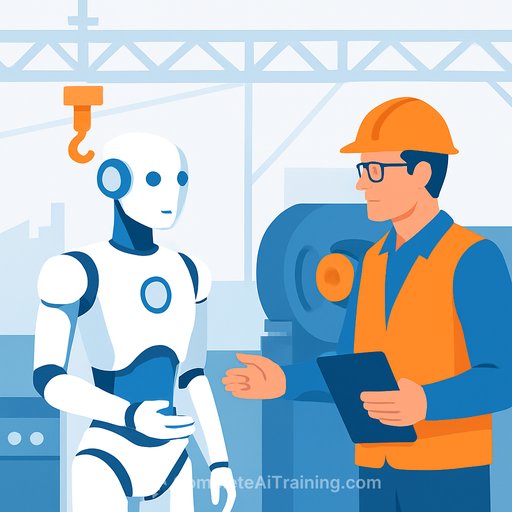
Louisiana signed an MOU with Persona AI to run a humanoid robotics pilot inside SSE Steel's fabrication facility in St. Bernard Parish. Facilitated by Louisiana Innovation (LA.IO) at Louisiana Economic Development (LED) with support from GNO, Inc., the pilot will collect real-world human movement and task data to guide how humanoids perceive, move, and work alongside skilled trades.
The goal: prove humanoid systems can operate where work already happens - on the shop floor, in environments built for people, not fenced-off automation. For IT and engineering teams, that means bringing AI, perception, and safety systems into live industrial workflows without breaking production or safety protocols.
Why this matters for IT and development teams
Persona AI will trial rugged humanoid platforms against steel fabrication tasks under actual operating constraints. That pushes requirements across data pipelines, edge compute, OT integration, safety systems, and human-in-the-loop control-areas your team will likely touch as these pilots scale.
Teams should consider Design principles for system architecture, data governance, and human-in-the-loop workflows.
LED's innovation lead framed it simply: this is applied innovation that helps small and midsize manufacturers modernize and create higher-skill roles. Persona AI CEO Nicolaus Radford added that Louisiana provides the industrial context needed to mature the tech and deploy at scale with partners like LA.IO, GNO, Inc., and SSE Steel.
What's happening on the shop floor
- Perception: multi-camera/depth sensing, glare and low-light handling, PPE/person detection, object segmentation around beams, plates, and tooling.
- Locomotion/manipulation: footstep planning across gratings and slick surfaces, compliant control around people, grasping irregular steel profiles.
- Human-in-the-loop: teleop and shared autonomy for tricky tasks, clear handoff between operator and robot, intuitive failure recovery.
- Safety: speed and separation monitoring, physical and wireless E-stops, geofencing, lockout/tagout tie-ins, event logging for audits.
- Integration: OPC UA/MQTT bridges to PLCs and MES/ERP, job ticket syncing, tool-state interlocks, shift scheduling hooks.
- Compute and networking: time-synced logging, edge GPUs, isolated VLANs, QoS for video/control, offline tolerance with safe fallback.
- Data: kinematics, force/torque, video, environment context, and human task traces-with strict privacy, retention, and access controls.
SSE Steel's COO Justin Airhart summed it up: test emerging tech on the floor, not in a lab - improving safety, Productivity, and long-term workforce sustainability.
Safety and compliance stay front and center
Pilots like this need clear safety cases and documentation that satisfy EHS, insurance, and site leadership. If you're involved, expect to contribute to hazard analyses, fail-safe design reviews, and incident response plans.
Useful reference: OSHA's robotics guidance outlines baseline expectations for industrial deployments. OSHA Robotics
Roles this pilot will create or upskill
- Robot technicians: calibration, maintenance, fault triage, part swaps.
- Systems engineers: PLC/MES integration, API bridges, data orchestration.
- Safety supervisors: SSM tuning, E-stop validation, audits, training.
- Ops specialists: task modeling, job sequencing, tooling interfaces.
- Data practitioners: labeling pipelines, event analytics, performance reporting.
The message from state and regional leaders is consistent: adoption changes some roles and creates others-with demand rising for people who can keep advanced machines productive and safe.
Your technical checklist (start here)
- Define bounded tasks: specific SKUs, tools, and stations where humanoids assist, not roam freely.
- Map controls: PLC tags, E-stop circuits, interlocks, and handshake points; decide on OPC UA/MQTT topics and schemas.
- Plan edge stack: GPU/CPU mix, time sync (PTP), video retention windows, offline behavior, and secure update paths.
- Segment networks: VLANs, firewall rules, certificates, least-privilege access, and audit trails.
- Data governance: who can view video; retention length; on-site vs. cloud; export controls; anonymization for human data.
- Safety case: SSM zones, force limits, geofences, LOTO procedures, drills, and documented sign-offs.
- Operator UX: teleop controls, alerting, shift turnover notes, and quick-recovery playbooks.
KPIs to prove value
- Safety: recordable incidents, near-misses, and safety stop activations per 100 hours.
- Throughput: task cycle time variance, job completion rate, and rework.
- Uptime: mean time between interventions, recovery time, and battery/thermal stability.
- Quality: defect rate by task class and time-to-detect anomalies.
- Integration: successful PLC/MES transactions, E-stop response time, and log completeness.
- Ops impact: operator workload reduction, training time, and cross-shift consistency.
Broader momentum, practical next steps
Humanoid pilots are picking up across manufacturing, maritime, energy, defense, and infrastructure-areas core to Louisiana's economy. This initiative gives developers a real lab-within-production to validate perception, control, and safety under constraints that actually matter.
If your team wants to prepare staff for AI-in-automation roles, review hands-on courses and certifications that focus on practical deployment. Automation training resources
Bottom line
Louisiana, Persona AI, LA.IO, GNO, Inc., and SSE Steel are moving humanoids from demos to daily work. For IT and development teams, this is a chance to wire up real systems, prove safe performance, and set the patterns others will follow.
Your membership also unlocks: