LSU Professor Outlines AI's Dual Role in Research as Data Centers Head to Louisiana
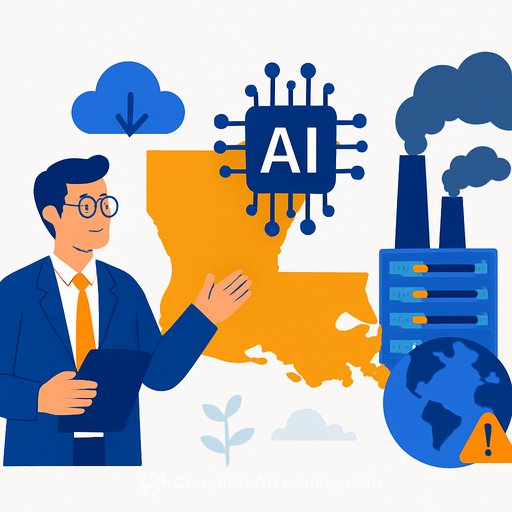
Louisiana will soon host one of the world's largest AI data centers. An LSU researcher used a campus talk this week to help students understand what that means for both scientific progress and resource consumption.
Supratik Mukhopadhyay, a professor and researcher at LSU, spoke Wednesday about AI applications in environmental science, wildfire prediction, and satellite imagery analysis. He presented both concrete benefits and serious limitations of the technology.
How AI Advances Environmental Research
Mukhopadhyay described work on DeepSat, an AI system trained to identify and classify features in satellite images-trees, buildings, water, roads. The program maps above-ground biomass across the nation, giving environmental scientists precise data on carbon capture in vegetation.
Before this tool, scientists manually assembled satellite images that often showed formations as mere pixels. The AI version completed the task faster and with comparable accuracy.
His team also built DeepFire, a wildfire prediction system that operates with more than 90% accuracy. The program analyzes weather data, vegetation type, wind speeds, and storm conditions to forecast wildfires days or weeks in advance. Once a fire starts, it predicts spread patterns to help first responders plan containment.
The system tracks lightning strikes in high-risk areas-a major wildfire trigger. Mukhopadhyay cautioned that predictions remain predictions. "Prediction itself is not enough," he said. The tool gives communities time to prepare, but offers no guarantees.
Where AI Fails Silently
Mukhopadhyay addressed a critical flaw in AI systems: they produce incorrect answers with unwarranted confidence, a problem researchers call "hallucinations."
He illustrated the issue with a hypothetical example. An AI trained only to identify giraffes and horses performs flawlessly on those animals. But feed it an elephant, and the system will classify it as either a giraffe or horse-whichever it perceives as more similar. The problem: the AI offers no warning that it encountered something outside its training.
In cancer cell research, this silent failure becomes dangerous. A misidentified cell goes unnoticed, potentially corrupting an entire study.
The Resource Cost
Generative AI systems consume enormous amounts of electricity and fresh water for cooling. Data centers emit significant heat that requires constant cooling to prevent equipment damage.
For Louisiana residents, this matters directly. "AI is coming to Louisiana," Mukhopadhyay said. "We need to be aware of how AI impacts our lives, especially in the environment, because if the environment is adversely affected, it will adversely affect our health."
What Student Organizers Want
The talk was hosted by the Student Alliance for AI Reform (SAFAR) and Geaux Green, organizations focused on educating the LSU community about AI's effects on academics and the environment.
Anderson Krupala, a SAFAR event planner, said the group wants students and faculty to implement AI "in the proper ways." He draws a line when AI makes decisions for users-submitting papers without personal review, or letting the tool write a student's own thoughts.
Ian Frick, president of Geaux Green, said the event clarified his thinking. "I can now counter large claims on both sides," he said. "I feel much more informed to contribute to that conversation and correct people's biases and misconceptions."
For researchers evaluating AI tools for your work, understanding both capabilities and failure modes is essential. AI for Science & Research resources can help you assess where these systems add value and where they introduce risk.
Your membership also unlocks: