
AI news ·
Major economies accelerate AI adoption across global air transport operations
63% of airlines now use AI for flight scheduling, maintenance, and disruption management, per the 2025 SITA report. The main barrier ahead is incomplete data-sharing between carriers, airports, and air traffic control.
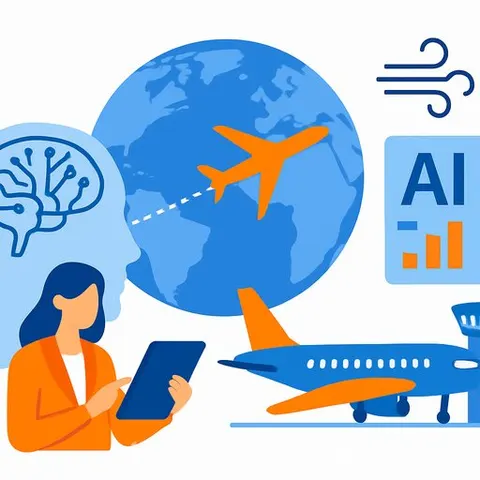
Major Airlines Worldwide Adopt AI for Flight Operations and Airport Management
The United States, India, Germany, the UK, France, Italy, Spain, and China are accelerating AI adoption across aviation operations. Airlines and airports in these countries are using AI to reduce delays, improve maintenance, and optimize passenger services as global travel demand recovers post-pandemic.
According to the 2025 SITA Air Transport IT Insights report, 63% of airlines globally now use AI for operational decision-making. The systems handle real-time flight scheduling, predictive maintenance, and disruption management-functions that directly affect a carrier's bottom line.
US Airlines Lead in Autonomous Systems and Safety
American Airlines and Delta Air Lines have integrated AI into flight operations and customer service. The Federal Aviation Administration is testing autonomous aircraft systems and air traffic control automation to streamline operations.
US carriers have reduced turnaround times and improved fuel efficiency through AI-powered systems. These gains contribute to both operational savings and sustainability goals.
India Positions Itself as an AI Aviation Hub
IndiGo Airlines and Air India have invested heavily in AI for predictive maintenance and flight scheduling. India's government supports this through the Digital India initiative, which promotes AI adoption across public services and aviation infrastructure.
India has become a significant player in AI research for autonomous systems and smart airport development, backed by government infrastructure investments.
Europe's Coordinated AI Rollout
Germany's air navigation service uses AI to optimize flight routing and airspace management. Frankfurt and Munich airports have implemented AI systems for passenger flow, baggage handling, and security operations.
London Heathrow Airport operates an AI-driven security and passenger screening system. The UK Civil Aviation Authority collaborates with private and public stakeholders to integrate AI safely into air traffic control.
France is testing AI systems for predictive flight management and autonomous aircraft trials. Spain's Madrid Barajas and Barcelona El Prat airports use AI for predictive maintenance and traffic management.
Italy's Rome Fiumicino Airport uses AI tools to streamline passenger flow and real-time flight management. Switzerland and the Netherlands focus on environmentally friendly air travel solutions through intelligent traffic systems.
China Builds a Smart Aviation Ecosystem
China Southern Airlines and Air China use machine learning to improve safety protocols and real-time flight optimization. China's integration of AI into air traffic control and airport automation is establishing infrastructure for a smart aviation system across one of the world's busiest aviation markets.
The Data Integration Challenge Ahead
While adoption is widespread, airlines and airports face a critical next step: integrating data across different platforms. Seamless data sharing between carriers, airports, and air traffic control systems remains incomplete.
Global collaboration on data-sharing frameworks and interoperable systems will determine how quickly the industry can realize AI's full potential. Trust in AI systems-among regulators, operators, and the public-remains an ongoing concern.
For management professionals overseeing aviation operations, the shift is clear: AI for Operations is no longer optional. Understanding how to implement and manage these systems is becoming essential to competitive performance. Leaders also benefit from understanding AI for Management principles to guide organizational adoption.