
AI news ·
Man uses AI to help design personalized cancer vaccine for his dog
An Australian AI consultant used ChatGPT and AlphaFold to help design a personalized mRNA cancer vaccine for his terminally ill dog, Rosie. Her tumors shrank after treatment - but scientists, not AI alone, made it happen.
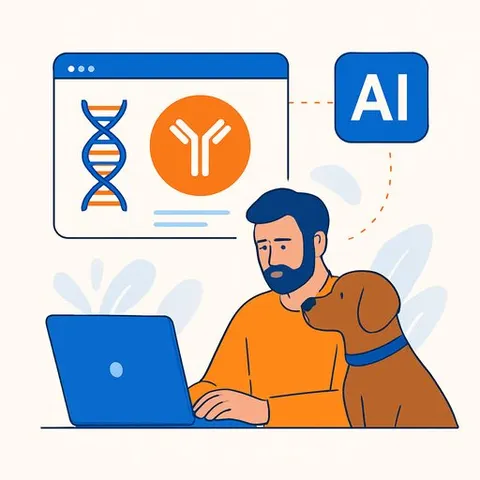
How an AI Consultant Used ChatGPT to Help His Dog's Cancer Treatment
Paul Conyngham is not a doctor, biologist, or chemist. He's an Australian AI consultant whose dog, Rosie, had terminal cancer. When veterinarians told him Rosie had one to six months to live, he used generative AI and large language models to design a personalized treatment plan.
After sequencing Rosie's tumor, Conyngham used ChatGPT and AlphaFold to help design neoantigens. He then connected with scientists who developed a personalized mRNA cancer vaccine. Rosie received the vaccine combined with an immune checkpoint inhibitor. Her largest tumors shrank, and her mobility improved.
The case matters not because AI replaced scientists, but because one person without formal medical training coordinated expertise, tools, and institutions to move an idea into action under time pressure.
What the Story Actually Shows
Most coverage of this case frames it as "AI solves cancer." That misses what actually happened. Conyngham did not work alone with a machine. He worked with sequencing labs, with AlphaFold outputs, with ChatGPT as a knowledge tool, and with real scientists who carried out critical steps.
The coordination itself was the rare skill. Conyngham had to move between domains-tumor sequencing, protein folding prediction, vaccine design, immunology-without stopping to become an expert in each one. He had to manage timelines, costs, laboratory logistics, and ethical steps. He had to keep momentum when each step depended on the previous one working.
Time was the binding constraint. Analysis had to be fast without being careless. Decisions had to be timely but grounded in evidence. In that setting, the combination of human judgment and machine-supported knowledge produced something neither could alone.
A Different Kind of Expertise
We usually define expertise as deep domain knowledge. That definition is correct. But there is another form that matters in real work: the ability to pull together knowledge, tools, institutions, data flows, and decisions quickly enough to produce action.
The human side contributed persistence, responsibility, coordination, and real-world execution. The machine side contributed speed, analytical support, and access to vast bodies of knowledge. One did not replace the other. Each amplified the other.
This case is worth attention for AI in science and research because it shows how generative AI functions in actual scientific work: not as a replacement for expertise, but as a tool that lets people coordinate across expertise faster than they otherwise could.
The story also shows what is invisible in most coverage. It does not show the failed attempts, wrong turns, emails with scientists, sequencing costs, software workflows, or the administrative steps required to move from an idea to a treatment. Those details matter. They are where real work happens.