PNG sets 2026 as the year AI moves into the core of government
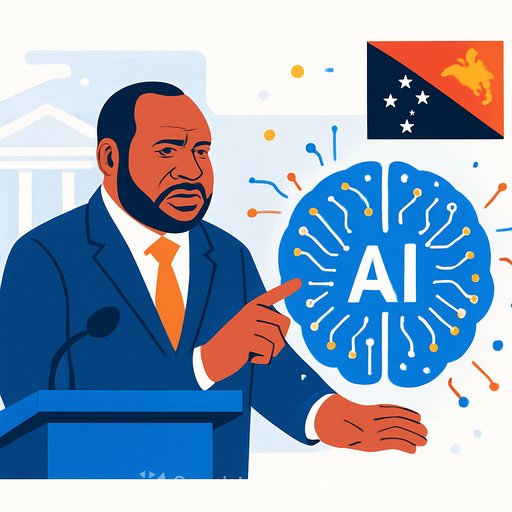
Prime Minister James Marape has set a clear directive: by 2026, artificial intelligence (AI) and ICT will sit at the center of how Papua New Guinea's public service makes decisions and delivers services. The aim is straightforward-lift governance, transparency, and efficiency across agencies.
AI will act as the "engine room" behind recruitment, contract awards, project assessments, policy design, and day-to-day performance management. For public sector leaders, this is less about buzzwords and more about building the next operating system for government work.
Where AI will show up first
- Recruitment and selections: Skills-based screening, standardized scoring, and anonymized shortlists to keep hiring fair and merit-focused.
- Contract awards: Price benchmarking, supplier risk checks, and anomaly detection to reduce leakage and speed up approvals.
- Project proposal assessments: Consistent scoring models, document summarization, and evidence cross-checks to raise quality and cut delays.
- Policy development: Scenario testing, stakeholder feedback synthesis, and impact summaries that help executive decision-making.
- System performance: Real-time dashboards tracking service levels, backlogs, and resolution times for faster course correction.
Guardrails that must come with it
- Legal fit: Map AI use to procurement law, data protection, and records rules. Document the legal basis for each use case.
- Accountability: Keep audit logs of model inputs, outputs, and overrides. Every decision that affects people should be explainable.
- Fairness and bias checks: Test models before launch and on a schedule. Publish summaries of results and remediation steps.
- Security: Classify data, apply least-privilege access, and monitor for model and API abuse.
- Human in the loop: AI proposes; officers decide. Set clear thresholds for when human review is mandatory.
- Public transparency: Plain-language notices on where AI is used, how to appeal, and how data is handled.
Practical steps agencies can start now
- Pick 3-5 high-value processes with measurable pain (long queues, high error rates, audit flags). Start pilots there.
- Clean the data at the source: unique IDs, deduplication, and standard forms beat fancy models every time.
- Build a simple AI policy covering acceptable uses, privacy, human oversight, and incident response.
- Stand up a cross-agency AI review board to approve use cases and share lessons learned.
- Set service-level targets before you deploy, then track weekly.
Procurement pointers (avoid vendor lock-in)
- Require data portability, open standards, and clear exit clauses.
- Keep model prompts, workflows, and evaluation datasets under government control.
- Start with pilots under 6 months, then scale what works.
- Ask for on-prem, private cloud, or sovereign options for sensitive workloads.
Metrics that matter
- Hiring cycle time and shortlist diversity.
- Variance in contract pricing and red-flag rates.
- Turnaround times for permits, payments, and complaints.
- Policy brief preparation time and evidence citations per brief.
- Audit findings closed on time and reduction in manual rework.
Risks to manage early
- Bias and unfair outcomes: use representative data and independent testing.
- Over-automation: keep human judgment in sensitive or rights-impacting decisions.
- Data leakage: restrict external model use and scrub sensitive data before use.
- Change fatigue: pair every new tool with simple SOPs, training, and accountable owners.
Skills and training for public servants
Every officer doesn't need to be a data scientist, but AI literacy is now part of the job. Leaders need to ask better questions, case owners need to review outputs with care, and analysts need stronger data skills.
- AI courses by job role for fast, role-relevant upskilling.
- AI certification for data analysis to strengthen evidence-based policy and reporting.
- AI Learning Path for Business Unit Managers for leaders implementing AI-driven governance and operational change.
Suggested timeline
- Now-Q1 2025: Readiness audit, pick pilots, set guardrails, train core teams.
- 2025: Run pilots in recruitment, procurement, and service delivery. Publish results and refine.
- 2026: Scale proven use cases, integrate dashboards, and formalize oversight.
This shift is big, but the goal is simple: faster services, cleaner processes, and decisions you can defend in public. Start small, measure hard, and keep people in control.
Further reading
- OECD AI Principles for trustworthy AI foundations.
- World Bank GovTech resources on digital public sector delivery.
Your membership also unlocks: