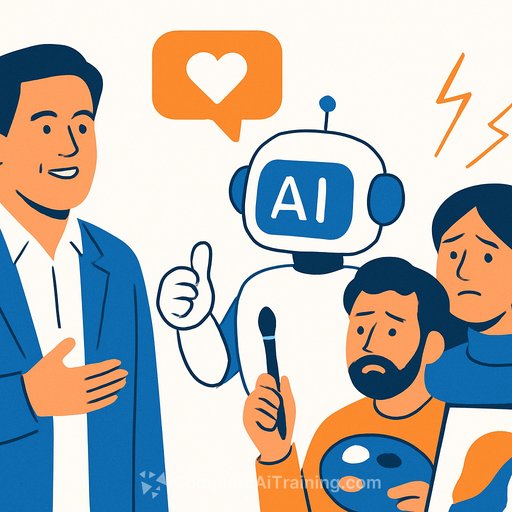
Creators vs. AI: Cuban Says "Love It." Many Artists Don't
AI is praised for speed. Creatives say it strips the soul. That tension exploded again after Mark Cuban told creators to "LOVE AI," arguing it doesn't make uncreative people creative-it "allows creators to become exponentially more creative."
The debate flared on the heels of a $1 billion deal between OpenAI and Disney that would let more than 200 Disney, Pixar, Marvel, and Star Wars characters appear inside Sora. Cuban, a tech-focused billionaire with an estimated $6 billion net worth, believes this moment tilts in favor of those who make things.
Cuban's Case: Speed, Scale, More Shots on Goal
"It allows creators to become exponentially more creative," Cuban wrote on X. He says AI is a time saver that can help develop a product "in minutes" rather than hours, days, or weeks.
His core point: most content fails anyway. "99% of content fails. With AI the cost and time it takes to experience and learn from those failures drop like a rock." In other words, more attempts, faster learning, better odds.
The Backlash: Art Isn't a Factory Line
Creatives pushed back. One response: "You're assuming that creating art is like running a business. You're not looking for efficiency. Sometimes the best work happens during the process."
Another film concept artist asked why Cuban is telling artists what to think: "If we're telling you the opposite, maybe you should listen… All you can see is dollar signs and 'value' instead of theft, exploitation, and job displacement." The argument isn't just about tools-it's about respect for process, credit, and control.
Why Many Creatives Don't Like AI
During the 2023 strikes, writers and actors warned studios could use chatbots to draft or rewrite scripts and deploy digital doubles that replace or reuse performances without fair pay. Those concerns haven't faded. See ongoing union guidance on AI and consent from groups like SAG-AFTRA.
There's also the training issue. As investor and music veteran David Pakman put it, there's a risk human creators become "feedstock" for AI systems trained on their work without explicit consent.
Surveys reflect the anxiety. A study from Queen Mary University of London found more than two-thirds of workers in creative industries believe AI has undermined their job security. And some analysts predict a divide between pre-AI and post-AI content, with audiences favoring earlier work as "true art."
A Practical Path That Respects Your Craft
- Use AI for grunt work, not the soul. Idea lists, beat sheets, rough comps, alt palettes, sound variations. Keep direction and taste in your hands.
- Protect your voice. Create a style sheet: themes, banned phrases, references you love, pacing rules. Force every AI pass to match your standards.
- Draw a line on rights. License assets. Ask clients where models and data come from. Credit collaborators. Decline gigs that ignore consent.
- Timebox the machine. Give yourself one or two AI passes, then finish by hand. Process is where originality shows up.
- Prototype more, publish smarter. Use fast iterations to test ideas with trusted audiences before investing weeks in final polish.
Bottom Line
AI won't make you creative. It can remove friction so your taste, judgment, and storytelling get more reps. For many artists, the issue is ethics and control-both valid concerns. The win is adopting the tool on your terms while pushing for consent, credit, and fair pay.
If you want structured practice with creative-friendly workflows, explore our curated picks for your role: AI courses by job and top generative video tools. For more case studies and resources on video-focused workflows, see our Generative Video tag.
Your membership also unlocks: