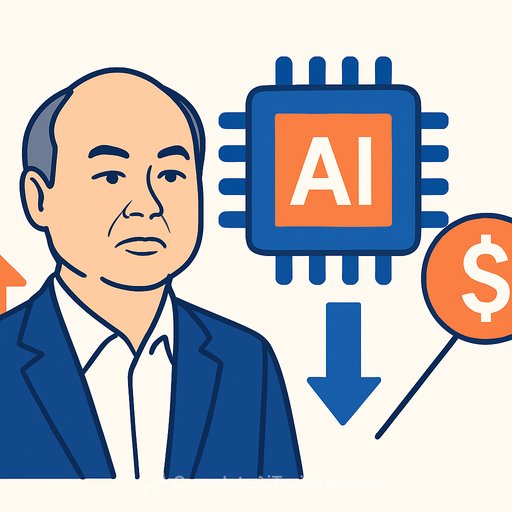
SoftBank's Nvidia Exit: Son Sells To Fund Bigger AI Bets
Masayoshi Son said the quiet part out loud: he sold SoftBank's Nvidia stake because he needed cash for the next phase of AI. If capital were unlimited, he wouldn't have sold a single share. "I was crying to sell Nvidia shares," he said at the FII Priority Asia forum in Tokyo.
He also pushed back on the "AI bubble" narrative. His case is simple: if AI earns even 10% of global GDP over time, trillions in cumulative spend will be justified. For him, this is an allocation question, not a hype cycle.
Where the Money's Going
SoftBank is moving from exposure to a dominant chip supplier into owning and building AI infrastructure and compute. That includes a Stargate data center project with Hon Hai (Foxconn), the acquisition of US chip designer Ampere Computing, and additional investment into OpenAI by year-end.
Translation for your models: SoftBank is trading liquid equity gains for harder, longer-dated assets-compute, energy-hungry data centers, and equity in foundational AI platforms. Duration risk goes up; so does potential upside if AI demand compounds.
Saudi Capital Still Matters
Son's remarks came at an offshoot of a major Saudi investment summit. The ties run deep: SoftBank's first Vision Fund was seeded with $45 billion from Saudi Arabia's Public Investment Fund (PIF).
PIF has deployed about $11.5 billion in Japan from 2017 to 2024 and expects that total to reach roughly $27 billion by 2030, according to Governor Yasir Al-Rumayyan at the same event. Japan's top officials, including Prime Minister Sanae Takaichi, also attended-signal of policy-level support for cross-border capital and AI infrastructure buildout.
Investor Takeaways
- Capital rotation: SoftBank is swapping liquid exposure to Nvidia for private equity, compute, and data center assets. Expect heavier capex, longer paybacks, and potentially lumpier cash flows.
- Compute supply chain: Ampere plus data centers equals a tighter grip on core inputs (CPUs, capacity, interconnects). Watch knock-on demand for networking gear, memory, and energy contracts.
- Signal vs. noise: A top allocator is redeploying into AI at scale, not trimming. That weakens the "bubble" case in the near term.
- Nvidia read-through: A single seller doesn't change demand for GPUs if AI infrastructure spend accelerates. If anything, data center construction is a tailwind for suppliers across the stack.
- OpenAI runway: More capital from SoftBank could support model training, inference capacity, and enterprise expansion.
- Hon Hai pipeline: Data center design, manufacturing, and integration revenue could lift as hyperscale builds expand.
What to Watch Next
- Deal flow and timing: Terms of the additional OpenAI investment; integration milestones for Ampere; financing structure for the Stargate build.
- Funding mix: Asset sales, asset-backed financing, or new partnerships to support ongoing capex without over-levering the balance sheet.
- Energy strategy: Long-term power agreements, grid access, and siting-determinants of data center unit economics.
- Policy risk: Export controls, CFIUS review for chip and data investments, and Japan-Saudi cooperation frameworks.
Why This Matters for Finance Teams
This is a case study in conviction-driven capital allocation under constraints. Selling a top-performing public stake to fund higher-beta, less liquid projects is a bold-yet coherent-portfolio move if you believe AI monetizes at scale.
For coverage models, tighten your scenarios around AI-related capex cycles, compute availability, and energy inputs. For portfolio construction, expect more GPs and strategics to recycle gains from 2023-2025 winners into private AI infrastructure over the next 12-24 months.
Quick Context
- Event: FII Priority Asia forum, Tokyo.
- Son's view: AI spend is justified if it captures ~10% of global GDP over time-"Where is the bubble?"
- Capital partners: Longstanding alignment with PIF; growing Saudi-Japan flows into technology and infrastructure.
Tools for Your Desk
If you're benchmarking vendors or building an internal watchlist for AI adoption in finance, this curated list of products can save time: AI tools for finance.
Your membership also unlocks: