SoftBank's high-conviction bet on OpenAI, a $200B vision for AI, and what Prism means for R&D teams
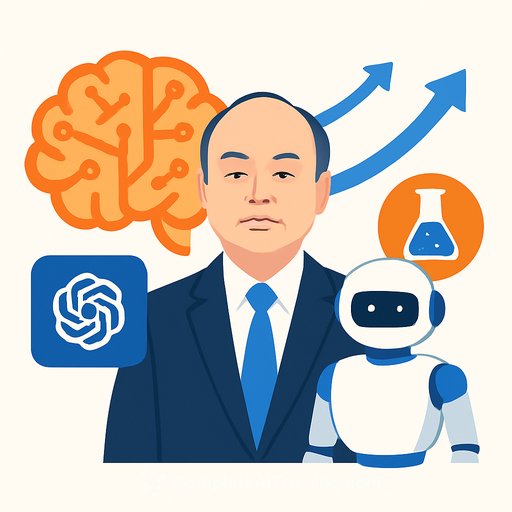
Masayoshi Son is pushing for scale. Reports indicate he's courting up to $200 billion for AI, while SoftBank explores an additional $30 billion investment in OpenAI on top of last December's $22.5 billion.
The market reacted fast. SoftBank's stock jumped as much as 8.8% in Tokyo after the news, then settled; it traded up about 3.7% the following day. You can track the stock here: SoftBank (9984.T).
Why this matters to product, engineering, and research leaders
- Compute access and model quality are on a steep trajectory. Whoever controls capital, chips, and talent sets the pace for everyone else.
- Vendor concentration risk is rising. If OpenAI becomes the core dependency, your cost, capability, and roadmap risk all sit with one provider.
- New workflow-native tools like Prism pull AI into daily research tasks, not just chat windows. Expect faster iteration cycles and tighter human-in-the-loop loops.
The capital stack: $30B talks, $50-100B raise, and a higher OpenAI valuation
SoftBank is in discussions to invest up to $30 billion more into OpenAI. The deal is not final; terms and size are still in motion. If it closes, SoftBank's stake rises beyond the ~11% it reached after the $22.5 billion investment in December.
In parallel, OpenAI is pursuing a larger raise of $50-100 billion with a target valuation in the $750-830 billion range. An IPO is on the table, and capital sources may include Middle Eastern sovereign funds and global VCs. Current investors include Thrive Capital, Khosla Ventures, and the UAE fund MGX.
SoftBank's moves to fund the bet
- Sold Nvidia shares for $5.8 billion.
- Reduced T-Mobile exposure and leveraged Arm stock for financing.
- Paused the Switch (US data center) acquisition to concentrate on AI.
- Acquired Ampere Computing for $6.5 billion and ABB's robotics business for $5.4 billion.
The intent is clear: concentrate assets around AI infrastructure, model supply, and enabling compute.
Risk profile: rating pressure, concentration, and LTV triggers
S&P Global flagged that aggressive AI exposure and Arm's volatility tighten SoftBank's credit headroom. If SoftBank adds $30 billion to OpenAI and marks its stake higher, the loan-to-value ratio could approach the 35% downgrade trigger. To keep disclosed LTV under 25%, SoftBank may need to raise at least $15 billion via asset sales and margin loans.
There's also concentration risk. At recent prices, OpenAI could surpass Arm as SoftBank's largest holding and exceed 30% of its asset value. Meanwhile, competition from Google's Gemini and Anthropic's Claude is real, while OpenAI's cash burn remains high due to training, inference, and top-talent costs.
Prism: turning AI into daily research workflow
OpenAI introduced Prism, a free tool for scientists available to any ChatGPT user. It runs on the GPT-5.2 model, supports LaTeX natively, enables paper drafting and edits, helps with literature retrieval, supports multi-user collaboration, and converts hand-drawn sketches into clean charts.
OpenAI's stated ambition: move from "general assistant" to "infrastructure for scientific discovery." The fit is logical. OpenAI says ChatGPT already handles about 8.4 million weekly messages in advanced science and math, with a projected 47% rise in 2025. One recent example cited in media: a statistics paper used GPT-5.2 Pro to produce a new proof, with humans guiding prompts and verification.
More detail on OpenAI's direction: OpenAI.
For practical templates and early case studies on AI-enabled lab workflows, see Research.
What Prism changes for teams
- Research velocity: faster drafts, structured math, and tighter feedback cycles across collaborators.
- Method rigor: LaTeX-first and reference-aware workflows reduce formatting overhead and context loss.
- Visual iteration: quick sketch-to-figure reduces the latency between idea and presentable asset.
Practical takeaways for product and research leaders
- Budget guardrails: model and inference costs can escalate quickly. Treat them like core infra-forecast, cap, and review monthly.
- Provider strategy: avoid single-vendor lock-in. Keep at least one parallel track with an alternative model provider for critical paths.
- Data pipelines: invest in retrieval, provenance, and evaluation harnesses. The model is only as useful as the data and checks surrounding it.
- Prism pilot: run a 4-6 week pilot in one domain (e.g., literature reviews, method write-ups, or figure generation). Measure time saved, error rates, and rework.
- IP and compliance: standardize prompts, outputs, and review steps for anything that touches proprietary methods or regulated data.
- Talent plan: budget for AI-fluent hires and upskilling. Pair senior scientists/engineers with AI operators to compress iteration loops.
What to watch next
- SoftBank's final investment size and structure, plus any asset sales or loans to maintain LTV.
- OpenAI's fundraising window, valuation signals, and any IPO milestones.
- Model quality and cost curves across OpenAI, Google, and Anthropic-especially for math-heavy and retrieval-heavy workloads.
- Prism adoption in labs and enterprises, and early benchmarks versus existing tooling.
If you're building AI capabilities inside a product or research org
Product and engineering leads can follow the AI Learning Path for Technology Managers for hands-on frameworks to run pilots and scale responsibly.
- Set a dual-vendor strategy for critical AI features.
- Pilot Prism in a narrow, measurable workflow and expand by proof, not hype.
- Codify evaluation: reproducible prompts, golden datasets, and regression checks on every model update.
- Track compute unit economics weekly, not quarterly.
Further learning
Explore role-based upskilling paths for engineering, data, and research teams: Complete AI Training - Courses by Job
Your membership also unlocks: