AI-ECG flags obstructive sleep apnea from a standard 12-lead ECG
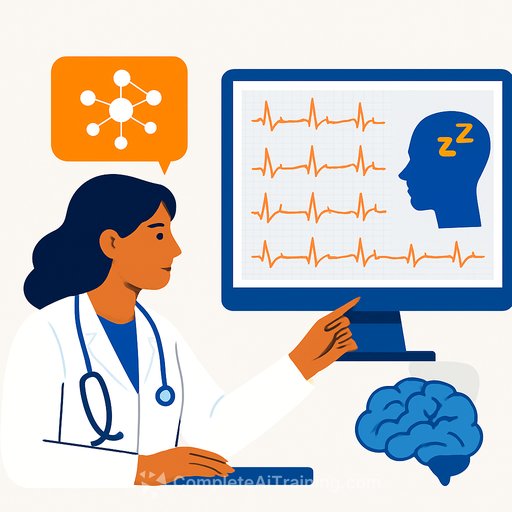
Jan. 20, 2026 - Mayo Clinic's Cardiovascular Medicine team trained a deep neural network on routine 12-lead ECGs to detect obstructive sleep apnea (OSA). The work, published in JACC: Advances, shows how a quick, low-cost test could screen patients who need full sleep evaluation and is a practical example of AI for Healthcare.
The model analyzed ECGs from 11,299 patients who underwent sleep studies at Mayo Clinic. For teams building clinical AI, this is a clear example of turning a ubiquitous signal into a practical triage tool without overhauling clinical workflows. Engineering and deployment teams can find patterns for MLOps, integration, and governance in AI for IT & Development.
Why this matters for IT and development teams
ECGs are everywhere. If screening can run on the same data, you cut friction, time, and cost compared to questionnaires and overnight testing.
"Using the ECG to screen for OSA may be a novel, widely applicable low-cost strategy for identifying patients who may be helped by further evaluation, diagnosis and treatment of OSA," says Virend Somers, M.D., Ph.D., senior author of the study.
Study at a glance
- Population: 11,299 adults (ages 47-68), 53.7% male. OSA defined as apnea-hypopnea index ≥ 5. Cases: 7,170. Controls: 4,129.
- Primary metric: Area under the ROC curve (AUC) = 0.80 (95% CI: 0.77-0.83) on the test set.
- Performance: Accuracy 73.7%, sensitivity 77.0%, specificity 68.6% - comparable or better than traditional screening questionnaires.
- Sex-specific results: Better in women (AUC 0.82; 95% CI: 0.79-0.86) than in men (AUC 0.73; 95% CI: 0.68-0.78). "This suggests that the OSA cardiac 'fingerprint' is more evident in women than in men," says Dr. Somers.
Clinical context to account for in your build
OSA is common, underdiagnosed, and tied to cardiovascular risk. Many patients don't know they have it; snoring can be a clue, but not everyone who snores has OSA.
- Physiology: Throat muscles relax during sleep and block airflow, causing repeated pauses in breathing.
- Cardiovascular strain: Drops in blood oxygen can raise blood pressure and stress the heart.
- Potential risks:
- Coronary artery disease
- Heart attack
- Heart failure
- Stroke
- Arrhythmias
- Sudden death
Engineering takeaways
- Signal choice: A standard 12-lead ECG carries enough information for OSA risk. The team also detected OSA using only 3 leads, suggesting future support for limited-lead devices.
- Integration: Screening can run pre-visit or at intake and push a risk score into the EHR for triage, referral, or sleep study scheduling.
- Thresholds: Tune cutoffs to match local goals (maximize sensitivity for catch-all screening vs. specificity to reduce false positives and downstream load).
- Fairness and stratification: Performance differed by sex; monitor subgroup metrics and consider calibration by cohort.
- MLOps basics: Track data drift, label leakage checks, audit trails, and model versioning. Align with clinical QA and change-control processes.
- Privacy and governance: ECG is PHI. Ensure HIPAA-compliant storage, access controls, and logging across training and inference.
Next steps from the study
"We were also able to pick up OSA using only 3 ECG leads rather than the standard 12-leads, so the screening may potentially be expanded to other ECG acquisition methods beyond the standard 12-lead ECG," says Dr. Somers.
The team also notes a key question for future work: whether a strong OSA signal on the ECG correlates with later cardiovascular disease and whether OSA treatment can lower that risk. That opens the door to risk stratification pipelines and outcome tracking once validated.
Practical implementation ideas
- Add AI-ECG screening as a background service on ECG ingestion, returning a risk score and recommended next step.
- Surface patient-friendly flags in portals while keeping clinician-facing explanations, confidence scores, and links to protocols.
- Pilot in cardiology and primary care first; measure referral rate changes, sleep lab throughput, and positive predictive value by site.
Resources
Citation
Covassin N, et al. Deep neural network algorithm using the electrocardiogram for detection of obstructive sleep apnea. JACC: Advances. 2025;4:102139.
Level up your AI build skills
If you're planning similar clinical ML pipelines or scaling MLOps across teams, browse curated paths by role: Complete AI Training - Courses by job.
Your membership also unlocks: