
AI news ·
McConaughey's AI deepfake trademark strategy offers limited protection without federal law, lawyers say
Matthew McConaughey registered eight federal trademarks covering his voice and likeness to fight AI deepfakes. The strategy has real teeth in commercial fraud cases but falls short when AI simply mimics him without claiming his endorsement.
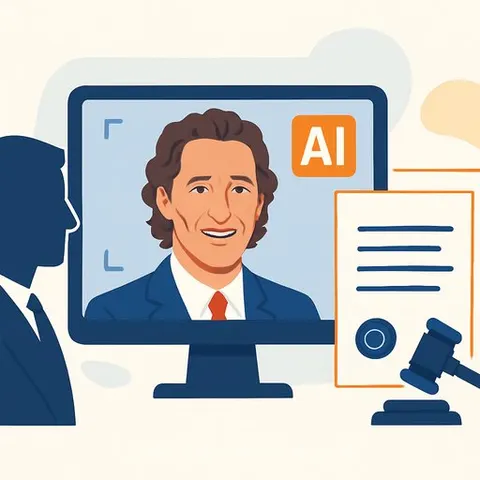
Matthew McConaughey's Trademark Strategy Against AI Deepfakes: Why It Works-and Why It Doesn't
Matthew McConaughey recently registered eight federal trademarks covering his distinctive voice and image, including his famous "alright, alright, alright" catchphrase. The move reflects a creative legal strategy to combat AI-generated impersonations, but it also exposes fundamental gaps in how intellectual property law handles deepfakes.
Through his company J.K. Livin Brands Inc., McConaughey registered sound marks capturing the pitch and cadence of his iconic lines, along with motion marks showing him on a porch and in front of a Christmas tree. All eight registrations fall under federal classes covering downloadable audiovisual media and entertainment services.
The Theory Behind the Trademark Approach
The strategy hinges on a straightforward argument: if someone uses AI to generate a convincing imitation of McConaughey's voice or likeness, his team can claim the imitation confuses consumers into thinking he endorsed or created that content. This allows them to file a federal trademark infringement claim under the Lanham Act.
Trademark registration offers procedural advantages over state-level right-of-publicity laws. It provides a legal presumption of validity and ownership, nationwide constructive notice, and access to enhanced damages and injunctive relief in federal court. For McConaughey's team, it's a stronger enforcement toolkit than what most state publicity-rights regimes provide.
Copyright and traditional publicity-rights laws don't fill the same role. Voice per se isn't copyrightable, and short catchphrases rarely are either. Right-of-publicity laws vary wildly by state, creating uncertainty for content distributed nationally online.
Where the Strategy Has Teeth
The strongest case for McConaughey's approach rests on a simple fact: certain phrases and mannerisms function as source identifiers. When people hear "alright, alright, alright" in his distinctive drawl, they immediately think McConaughey-and by extension, his brand and entertainment services.
There's also a dilution argument. Under the Lanham Act, owners of famous marks can stop uses that blur distinctiveness or tarnish reputation, even without proving consumer confusion. If McConaughey's marks qualify as famous, that's a powerful additional avenue that bypasses the traditional likelihood-of-confusion analysis.
The Fundamental Problem
Trademark law protects source identifiers. Its purpose is preventing consumer confusion about who created or sold something. It was never designed as a general-purpose right-of-publicity tool or a mechanism for controlling how a person's persona is used.
The most worrisome AI deepfake scenarios don't involve source confusion. If someone generates a video of an AI McConaughey delivering a monologue on YouTube, or an AI voice clone narrating a podcast, the infringer typically isn't trying to trick consumers into thinking McConaughey created it. The AI-generated McConaughey is the product itself, not a source identifier for someone else's goods or services.
A federal court in Lehrman v. Lovo made this distinction explicit: "even extremely famous celebrities" cannot use trademark claims "based on the use of their likeness as products rather than as source-identifying marks."
Training Data and Downstream Use
Using McConaughey's voice or image as training data for an AI model generally doesn't trigger trademark liability. Feeding a machine-learning system with his voice isn't "use in commerce" that identifies the source of goods or services.
The developer of an AI tool isn't liable for trademark infringement simply because the tool can generate McConaughey-sounding output. The liability question shifts only when someone takes that AI-generated output and uses it to promote their own goods or services in a way that confuses consumers-for example, using a fake McConaughey voice in an advertisement to suggest he endorsed a product.
In that scenario, the trademark registration adds procedural benefits, but it's not filling a gap that didn't already exist. Right-of-publicity law would likely apply anyway.
The Gray Zone Where Trademark Struggles
The real gap is in semi-creative, semi-commercial AI content monetized through YouTube or TikTok ads. That's precisely where trademark law's source-identification requirement becomes hardest to satisfy-and where the law is least clear.
McConaughey's registrations create friction and raise compliance costs for potential infringers. Even if a court ultimately finds the trademark doesn't cover a particular use, the registration itself has deterrent value and gives his team stronger cease-and-desist letters. It's a smart tactical move, but not a complete solution.
What Comes Next
Federal legislation is the only real answer. Bills like the NO FAKES Act would create a federal private right of action specifically against unauthorized AI-generated replicas-a purpose-built tool for this problem.
Until Congress acts, creative strategies like McConaughey's represent the best practitioners can offer. They're working around the edges of a legal framework that wasn't designed for AI deepfakes. For creatives navigating these issues, understanding both the benefits and limits of trademark protection is essential as the technology continues to advance.
Learn more about how AI affects creative professionals and the intellectual property challenges emerging from generative art technologies.