McDonald's AI Overhaul Rewrites the Operating Manual for Retail
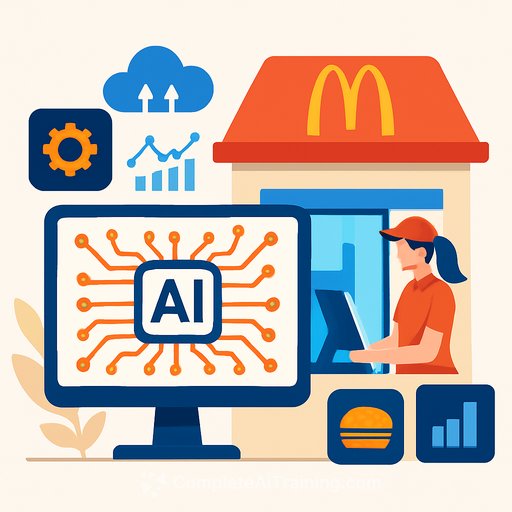
The headlines focus on burger-flipping robots and AI-powered drive-thrus. What's actually happening is McDonald's is turning every restaurant into a software-defined, data-driven system where changing menus, labor models, or business operations becomes a software update, not a reinvention. For operations leaders across quick-service restaurants and retail, this is the roadmap you're about to follow.
For decades, McDonald's competitive advantage came from real estate, supply chain discipline, and process standardization. In an AI-first world, that advantage shifts to intelligence. An AI-powered system sees in real time what's selling, how weather and local events shift demand, how long orders take at each station, which promotions work, and which locations are understaffed or overstaffed.
The next step is models that don't just observe data-they act on it. Menus reconfigure based on demand and inventory. Pricing flexes within set guardrails. Upsell logic changes by time of day or order history. Labor schedules anticipate Friday's rush before managers feel it. Kitchen workflows re-sequence tasks to remove bottlenecks.
Once that operating system is standardized across thousands of locations, McDonald's operates like a software company: test a change in one market, learn fast, push an update globally. You're now running on an operating system.
How AI Redraws the Division of Labor
The real shift isn't automation for its own sake. It's how AI quietly redraws who does what.
In the old model, people handled almost everything-taking orders, assembling food, managing complaints. In the new model, algorithms handle the logic of ordering, pricing, and personalization. Automation takes on repetitive back-of-house tasks. Humans are pushed into the edges: exception handling, hospitality, troubleshooting, and oversight.
The easy parts disappear first. Tapping in orders, making changes, repeating upsell scripts-these go away. What's left? You're dealing with frustrated customers when the system fails and decisions that don't fit the pattern the model expects.
This pattern will spread across global retail. Cashiers give way to computer vision and self-checkout. Generic sales associates give way to smaller teams of specialists. Store managers stop flying blind and start staring at dashboards that tell them what to do next.
The labor debate gets framed as "robots versus workers." That's the wrong lens. AI is hollowing out the middle. Routine, repeatable roles will shrink. High-skill, high-empathy, and high-accountability roles will grow. Operators who don't redesign jobs, retrain people, and create new career paths will experience this as churn and burnout, not efficiency.
Why This Happens at McDonald's First
McDonald's has massive scale, highly standardized processes, enormous transaction volume, and razor-thin margins. That's the perfect environment for AI: tons of data to learn from, clear definitions of success, and workflows that repeat thousands of times a day.
If AI can reliably take orders, optimize kitchens, and manage labor during an evening rush at a busy McDonald's, it can do the same in big-box retail, pharmacies, convenience stores, hotels, and airports. McDonald's is effectively funding the R&D for the rest of global retail.
The integration patterns they figure out, the failure modes they hit, and the consumer reactions they trigger will become the playbook everyone copies. You may not have their budget, but you'll absolutely live in the world their experiments create.
What This Looks Like for Customers
For customers, this won't feel like a robot takeover. It will feel like an upgraded experience. Orders are more accurate with fewer handoffs. Wait times shrink because the system sees the rush coming. Menus feel more relevant because they're tuned to local tastes and real-time conditions. The app remembers what you like and suggests it before you think about it.
For younger generations growing up with AI, this will be normal. Their toys talk back, their homework is AI-assisted, and their expectations are shaped by systems that feel instant, personalized, and always on. Standing in a long line to shout an order at a human will feel as archaic as writing a check at the grocery store.
That creates two big consequences. First, frictionless service stops being a differentiator and becomes the minimum requirement. If your brand can't match the speed, personalization, and reliability of an AI-powered experience, you're invisible. Second, human interaction becomes a premium feature. The rare moments when a customer interacts with a person matter more. That's where loyalty is built or lost.
The Real Risks
None of this is risk-free. Models mishear orders, misprice items, prioritize the wrong customers. They go down at the worst possible time. If your models are trained on historical data, they may quietly encode and amplify patterns you don't want-like who gets offered deals, who gets prioritized in the drive-thru, or which neighborhoods see certain promotions.
When something goes wrong, who owns the mistake: the brand, the franchisee, or the vendor who built the system?
Operators need governance and monitoring, not just new features. They need clear human override and escalation paths built into every AI-driven workflow. They need to train staff to use the tools and challenge them when the output doesn't make sense. The winners won't be the ones with the flashiest robots on social media. They'll be the ones that marry AI-driven efficiency with human judgment and accountability.
What Operations Leaders Should Do Now
Stop thinking in terms of gadgets. This isn't about "trying a kiosk" or "testing an AI drive-thru voice." It's about recognizing your business is becoming a real-time system. Ask simple but uncomfortable questions: What data are we actually collecting? Where does it live? Who can see it? Which decisions are still being made by gut that could be made better with data and models?
Map your workflows. Where are the repetitive, low-judgment tasks that could be automated without hurting the guest experience? Where are the decisions that could be augmented-forecasting, inventory, staffing, pricing-so managers aren't flying blind? And where are the moments you should protect as distinctly human because they require empathy, nuance, and accountability?
Invest in your people as aggressively as you invest in platforms. The job description for a shift lead or general manager will look very different soon. They'll be managing systems as much as schedules, interpreting AI recommendations, overriding them when they conflict with reality on the ground, and using the time savings to deliver better hospitality-not just shave labor hours.
Learn more about how AI transforms operations by exploring AI for Operations or the AI Learning Path for Operations Managers.
The Bottom Line
McDonald's AI makeover isn't really about robots flipping burgers. It's about a global retailer rewriting its codebase for an intelligent, always-on world. The real question isn't whether the robots are coming. It's whether, when the new operating system for retail is fully installed, your brand will still be relevant, or stuck running yesterday's playbook in tomorrow's world.
Your membership also unlocks: