How McDonald's is applying AI to operations: accuracy, speed, and loyalty
McDonald's is leaning into AI to tighten order accuracy, move cars faster, and reduce friction for crews. CEO Chris Kempczinski said the company has multiple teams testing AI to improve the customer and crew experience, including voice and analytics tools. Some of it is live, some of it is still being tested. For operators, the signal is clear: pick narrow problems, measure hard, and iterate.
AI "Accuracy Scales": verify the order, not the guess
McDonald's announced an AI-powered scale system that compares expected order weight to actual weight to catch mistakes before food leaves the window. The company said in a 2025 statement it has deployed this across thousands of restaurants for drive-thru and delivery, with more to come. It's a simple control loop: POS data in, expected weight calculated, discrepancy flagged, staff corrects.
- Data needed: item-level weights, packaging weights, and combos; integrated with POS and kitchen display.
- Set thresholds: what variance triggers a recheck (e.g., ±3-5%) and when to auto-escalate to a manager.
- Calibrate routinely: scales drift; build in daily checks and maintenance schedules.
- Measure impact: track remakes, refunds, drive-thru seconds per car, and delivery adjustments pre/post.
Voice bots for ordering: promising, but accuracy rules
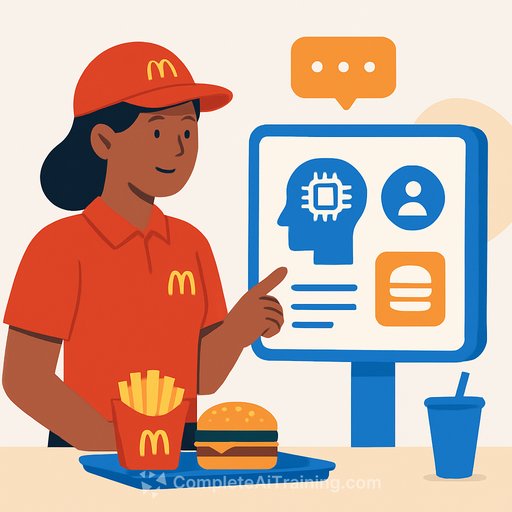
McDonald's explored AI voice agents for drive-thru ordering to reduce load on front-line staff. After two years with a vendor, the program paused in 2024 because accuracy landed in the 80% range versus a 95% target reported by industry press. That's the lesson: without near-human accuracy, the rework and guest friction erase the labor savings.
- Operate on confidence thresholds: route low-confidence orders to a crew member instantly.
- Engineer for noise: mics, echo cancellation, accent diversity, and weather conditions matter more than the model on paper.
- Limit scope first: start with core items and common modifiers; add edge cases later.
- Live monitoring: show agents real-time transcripts, dropped intents, and handoff rates; fix with targeted data, not guesses.
- Human-first fallback: make handoff seamless so customers don't notice the switch.
For industry coverage of the voice pilot and benchmarks, see National Restaurant News.
Personalized offers through the app: loyalty with guardrails
McDonald's is using AI to personalize offers and digital engagement via the MyMcDonald's Rewards program. The goal is simple: show the right deal to the right repeat visitor and lift visit frequency. That requires solid first-party data, offer logic, and frequency caps so marketing helps, not annoys.
- Define objective: visit lift, check lift, or item trial-optimize for one KPI at a time.
- Governance: cap messages per week, control discount depth, and protect margins.
- Feedback loop: tie offer redemptions back to cohorts and suppress what doesn't move the needle.
- Privacy: keep consent clear and give users simple controls for data and notifications.
For broader context on AI use in food and beverage, see New Food Magazine.
Metrics operations leaders should track
- Accuracy: remake rate, refund rate, delivery adjustments, scale variance flags per 100 orders.
- Speed: seconds per car, cars per hour, average handle time for handoffs from bot to human.
- Labor: labor minutes per 100 transactions, task time saved in order assembly and verification.
- Digital: offer redemption rate, visit frequency, opt-out rate, app MAUs and order mix shifts.
- Quality: customer complaints per 1,000 orders, CSAT/NPS on drive-thru and delivery.
- Reliability: bot accuracy, confidence distribution, and uptime; scale calibration pass rate.
Implementation playbook you can reuse
- Pick one use case with clear ROI (e.g., scale-based verification for delivery orders).
- Define a hard target (e.g., reduce remakes by 30% in 60 days) and instrument the baseline first.
- Pilot in 3-10 stores with different volumes and layouts; A/B by daypart if possible.
- Write exception workflows before launch: who fixes what, and in how many seconds.
- Train the floor: short scripts, visual prompts, and one owner per shift.
- Review weekly: kill what doesn't work, double down on what does, then scale in waves.
- Mind TCO: include hardware, calibration, data labeling, and support-not just license fees.
Bottom line for operations
McDonald's is showing where AI helps most: verification, throughput, and targeted offers. The tech is secondary to the system around it-clean data, clear thresholds, fast handoffs, and relentless measurement. Start small, prove value, and scale with discipline.
If you're upskilling your ops team on applied AI, explore the AI Learning Path for Training & Development Managers.
Your membership also unlocks: