Merck and Mayo Clinic Partner to Apply AI to Drug Discovery and Precision Medicine
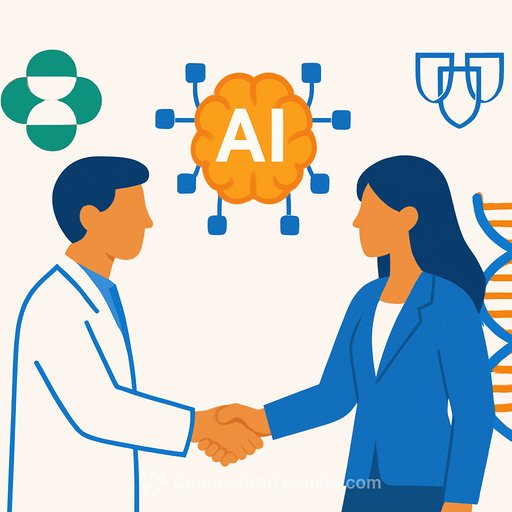
Merck and Mayo Clinic announced a large-scale R&D collaboration to apply AI, advanced analytics, and multimodal clinical data to accelerate discovery and early development decisions.
The agreement connects Mayo Clinic Platform-including its de-identified clinical and genomic datasets, registries, biorepositories, and scalable analytics-with Merck's AI and ML research, spanning computational and spatial biology, AI foundation models, and real-world data.
What's actually being integrated
- Mayo Clinic Platform_Orchestrate: direct access to de-identified multimodal data, clinical expertise, advanced AI tools, and the ability to scale solutions in a secure environment.
- Multimodal data types: lab results, medical imaging, clinical notes, molecular and genomic data-used to validate AI models and inform discovery strategies.
- AI-enabled "virtual cell" research at Merck to improve target identification and guide early program decisions.
"New technologies are enhancing our ability to innovate with the potential to bring important new therapies to patients faster. By working with Mayo Clinic, we aim to integrate high-quality clinical data and AI-enabled insights into discovery research to improve target identification, and ultimately, the probability of success for our programs," said Robert M. Davis, chairman and CEO, Merck.
"By combining Mayo Clinic Platform's de-identified data, clinical expertise and Platform technology with Merck's world-class research and development capabilities, we are poised to speed innovative breakthroughs to patients and redefine drug development," said Gianrico Farrugia, M.D., president and CEO, Mayo Clinic.
Initial focus areas
- Gastroenterology: Inflammatory Bowel Disease (IBD)
- Dermatology: Atopic dermatitis
- Neurology: Multiple sclerosis
Why this matters for IT and development teams
- Multimodal AI is moving from pilots to production: EHR + imaging + genomics + unstructured notes require unified data contracts, feature stores, and reproducible pipelines.
- De-identification and governance are first-class requirements: PHI scrubbing, audit trails, lineage, and access controls must be automated and testable.
- Validation at scale: External, diverse datasets will pressure-test generalization, bias, and clinical relevance-expect stricter evaluation protocols and documented model cards.
- Foundation models for biology: Expect workflows that fine-tune or adapt pretrained models for cell states, tissue context, and disease progression using limited labeled data.
- GxP-aware MLOps: Version everything (data, code, models, environments), enforce reproducibility, and prepare for inspection-ready logs.
Practical build notes
- Interoperability: Normalize to FHIR/HL7 for EHR, DICOM for imaging, and common genomics formats (VCF, BAM/CRAM). Lock schema early.
- Pipelines: Create modality-specific ETL then a unifying layer that aligns patient/time indices; add late-fusion and early-fusion options for modeling.
- Feature management: Centralize embeddings (notes, images, omics) in a feature store with TTL, PII checks, and lineage.
- Evaluation: Define per-modality metrics plus composite endpoints; test across subpopulations to catch performance drift and hidden failure modes.
- Security: Isolate compute, restrict egress, apply policy-as-code for data access, and monitor for re-identification risk.
What to watch next
- Published validation results on multimodal benchmarks relevant to IBD, atopic dermatitis, and multiple sclerosis.
- Evidence of improved target identification and earlier go/no-go decisions in Merck's pipeline.
- Reusable components: data schemas, evaluation frameworks, and MLOps patterns that other teams can adopt.
About the organizations
Merck (MSD outside the U.S. and Canada) is a research-intensive biopharmaceutical company focused on developing medicines and vaccines for people and animals. Learn more at merck.com.
Mayo Clinic is a nonprofit healthcare organization focused on clinical practice, education, and research. Its Platform brings together data and tools to accelerate healthcare innovation. Explore the platform at Mayo Clinic Platform.
Level up your team's AI skillset
- AI for Healthcare - practical resources for building compliant, multimodal workflows in clinical settings.
- AI Learning Path for Research Scientists - a structured path for developers and R&D teams working on scientific AI.
Your membership also unlocks: