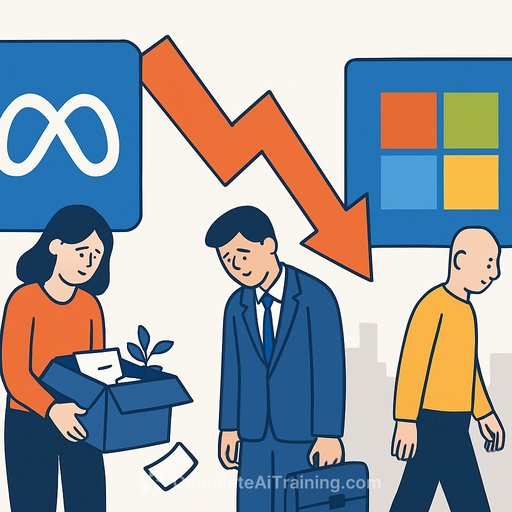
Meta and Microsoft announce mass layoffs as tech sector cuts exceed 92,000 jobs
Meta will cut 8,000 jobs starting May 20, while Microsoft is offering buyouts to approximately 8,750 U.S. employees. The two announcements pushed 2026 tech sector job losses past 92,000, with 95 companies announcing cuts since January.
Meta's internal memo framed the cuts as a matter of "efficiency" and "offsetting the other investments we're making"-a direct reference to the company's $135 billion AI spending this year. The company will eliminate 10 percent of its 80,000-person workforce and leave roughly 6,000 vacant positions unfilled.
Microsoft is also restructuring to offset heavy spending on data centers and AI infrastructure. Both companies presented the layoffs as necessary cost management tied to their AI investments.
How companies are justifying the cuts
Tech executives have begun using AI as the public rationale for workforce reductions. Meta CEO Mark Zuckerberg said "2026 will be the year when AI fundamentally transforms our work processes." Block CEO Jack Dorsey previously highlighted the financial benefits of replacing employees with AI technology.
Business media has adopted similar framing. The Wall Street Journal described Meta's cuts as part of a "relentless shift toward AI," while Bloomberg attributed the reductions to the company's need to "trim workforces" amid heavy AI spending. BBC reported that tech CEOs now routinely claim AI enables companies to do "more with fewer staff members."
Fortune recently warned of "the AI layoff trap," noting that companies are using rapid AI adoption to rationalize cuts that would otherwise appear as straightforward corporate downsizing.
The structure of the cuts
Meta's layoffs are being organized in waves, with workers told terminations will begin May 20. The company is also halting hiring into thousands of open positions rather than filling them.
Microsoft's approach differs in form but not substance. The company is offering "voluntary" separation buyouts-the first in its 51-year history-effectively pushing workers out under the appearance of choice.
Meta's HR chief Janelle Gale said the cuts were "the best path forward, given the circumstances," framing the decision as unavoidable. Reuters reported that Meta initially leaked the layoff news before confirming it, with additional cuts planned later in 2026, creating prolonged uncertainty for remaining staff.
The financial picture
Wall Street's response has been predictable. Meta's stock fell on Thursday, then rebounded and exceeded previous levels. Microsoft shares followed the same pattern, dipping Thursday before bouncing back by Monday.
The market is pricing in massive capital expenditures. Amazon, Google, Meta, and Microsoft are expected to spend approximately $650 billion on capital expenditures in 2026, much of it connected to AI infrastructure.
These companies simultaneously maintained stock buybacks and executive compensation while announcing layoffs. Wall Street is effectively rewarding a model in which workers are discarded so that AI investments can be funded and shareholder value preserved.
Scale of 2026 cuts
The pace of layoffs is accelerating. Layoffs.fyi data cited by CNBC shows more than 92,000 tech employees cut in 2026. Last year, the sector saw 154,445 layoff announcements across the full year, with 52,050 announced by the end of March.
Major reductions last year included Microsoft, Intel, Amazon, Verizon, and HP. All continued funding stock buybacks and executive compensation while cutting staff.
What executives should understand
This wave of cuts represents a deliberate corporate strategy, not an inevitable consequence of AI adoption. Companies are using AI as cover for a broader reorganization of work designed to reduce labor costs and shift expenses onto remaining employees.
For strategy and operations leaders, the pattern is clear: AI spending and workforce reduction are operating as two sides of the same decision. Understanding this dynamic is essential for anyone managing through organizational transformation.
Learn more about AI for Executives & Strategy and AI Agents & Automation to understand how these technologies are reshaping business operations and workforce planning.
Your membership also unlocks: