
AI news ·
Meta begins recording employee keystrokes and mouse movements to train AI models
Meta will record employee keystrokes, mouse movements, and app interactions to train its AI models, the company confirmed April 21. Privacy advocates and some staff are pushing back over where workplace monitoring ends and data collection begins.
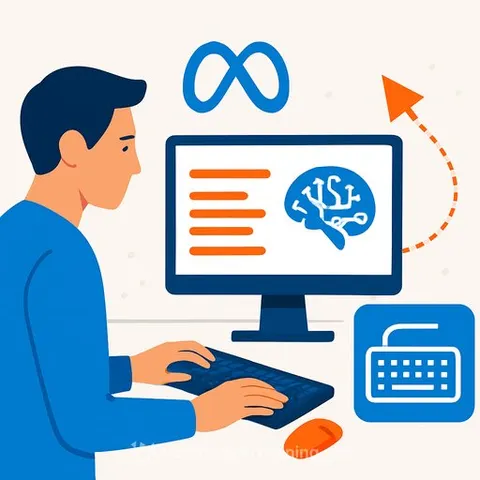
Meta to Record Employee Keystrokes for AI Training, Raising Privacy Concerns
Meta announced on April 21 that it will record employee keystrokes, mouse movements, and application interactions to train its artificial intelligence models. The move has triggered immediate pushback from privacy advocates and raises questions about where workplace monitoring ends and data exploitation begins.
The company will deploy internal tools that capture how employees interact with specific applications during work hours. According to Meta, this data-including keystroke patterns, button clicks, and navigation through menus-is necessary to build AI agents capable of assisting people with routine computer tasks.
A Meta spokesperson told Reuters: "If we're building agents to help people complete everyday tasks using computers, our models need real examples of how people actually use them." The company says safeguards exist to protect sensitive content and that collected data serves only for AI training.
The Broader Data Collection Trend
Meta's announcement reflects a wider industry pattern. Last week, reports surfaced of startups being approached for access to their historical Slack archives, Jira tickets, and internal messaging data. These communications, once treated as private corporate records, are becoming valuable training material as AI companies search for new data sources.
The demand stems from a fundamental requirement: large language models need massive datasets to learn patterns and generate appropriate responses. As publicly available internet data becomes increasingly restricted through robots.txt files and licensing agreements, companies are turning inward.
Technical Safeguards vs. Real-World Risk
Meta's technical documentation outlines several protective layers: selective application monitoring, content filtering algorithms, strict access controls, encryption, and automatic data deletion after training completion.
Cybersecurity analyst Michael Chen questions whether these measures fully prevent misuse. "To train AI on human-computer interaction patterns, you need to capture those patterns authentically," he said. "Any filtering or anonymization reduces training data value, creating tension between utility and privacy."
Dr. Elena Rodriguez, director of the Center for Digital Ethics at Stanford University, said: "When yesterday's internal communications become today's training data, we're fundamentally redefining workplace privacy boundaries. Employees reasonably expect their work communications to remain within the company, not become fodder for machine learning algorithms."
Legal Uncertainty
The legal framework varies significantly by region. The European Union's General Data Protection Regulation (GDPR) requires explicit employee consent and strict data minimization. California's Consumer Privacy Act (CCPA) and newer state privacy laws create additional compliance challenges.
Labor attorney Sarah Johnson noted that employment law predates AI training requirements. "Existing regulations generally address surveillance for productivity monitoring or security," she said. "Using employee behavior as training data for commercial AI systems represents a new category that existing laws don't adequately cover."
Employee Response
Anonymous feedback from Meta employees, gathered through professional networks, shows mixed reactions. Some technical staff understand the technical necessity. Others object to the scope.
One software engineer said: "There's a difference between knowing your work is being evaluated and knowing your every keystroke might train a commercial AI system."
Organizational psychologist Dr. Robert Kim warned that constant monitoring could damage innovation. "When employees feel constantly monitored, they may become more risk-averse and less creative," he said. "The knowledge that exploratory work or early drafts could become permanent training data might inhibit the very innovation these AI systems are meant to support."
Competitive Pressure and Industry Comparison
Meta's move reflects intense competition in AI development, where access to quality training data provides significant advantage. Other major technology companies have expanded their data collection methodologies, though with varying transparency.
- Google relies primarily on search data, YouTube content, and public datasets, with limited internal testing data and high public transparency through published research.
- Microsoft uses GitHub, professional networks, and enterprise data, including anonymized productivity patterns.
- OpenAI relies on licensed content and partnerships, with minimal direct employee data collection.
What Comes Next
Industry analysts predict several developments. Regulators may mandate clearer disclosures about data sources. New employee rights specifically addressing AI training use of employee data may emerge. Companies may increase investment in synthetic data generation to reduce reliance on human-generated training material.
Meta's decision marks a significant moment in how AI development intersects with workplace privacy. The tension between data requirements and ethical considerations will likely intensify as AI systems become more embedded in work environments.
For IT and development professionals, understanding AI for IT & Development and Data Analysis practices becomes essential as these issues affect how organizations handle employee data and model training.