Meta breaks ground on a $10B Indiana data center: what this signals for builders and developers
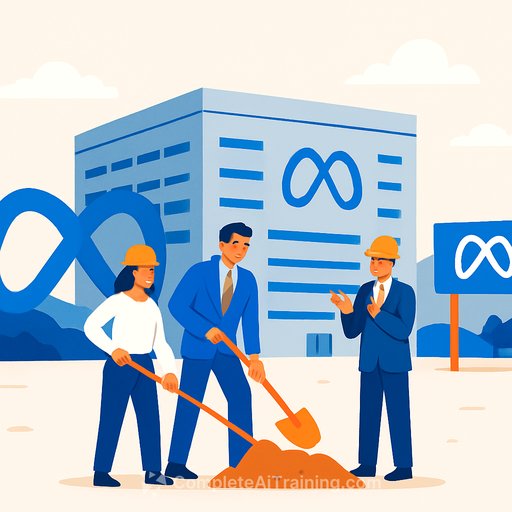
Meta has started construction on a $10 billion data center in Indiana to expand its AI compute capacity. For real estate and construction pros, this is a clear cue: hyperscale demand is accelerating across the Midwest, and the work is deep infrastructure, not cosmetic buildouts.
Why this matters
- Hyperscale AI facilities are capital-heavy, schedule-driven, and utility-dependent - perfect territory for firms with industrial and mission-critical experience.
- Sites near high-voltage transmission, fiber backbones, and abundant water access will see increased interest and pricing pressure.
- Owners are consolidating vendor lists. Prequalification, safety records, and proven delivery on complex MEP systems will decide who gets a seat at the table.
Site and infrastructure requirements you should anticipate
- Electrical service: Very high loads requiring new or expanded substations, dual feeds, and close coordination with utilities and regional operators.
- Cooling: Higher-density AI compute leans into advanced cooling - expect growing use of liquid solutions, heat rejection upgrades, and tight thermal envelopes.
- Fiber: Diverse routes, low-latency paths, and secure meet-me points. Early carrier engagement prevents redesigns later.
- Water and environmental: Water rights, reuse, and discharge planning will face scrutiny. Build early relationships with local authorities.
- Security and resilience: Hardened perimeters, compartmentalized interiors, and fault-tolerant systems throughout.
Construction scope and long-lead realities
- Core build: Steel, tilt-up or precast, deep foundations where needed, and large equipment yards for chillers, dry coolers, and standby generation.
- MEP/controls: High-voltage transformers, switchgear, UPS, busways, PDUs, BMS/EPMS, and white space fit-out with high-density racks.
- Long-lead items: Transformers, medium- and low-voltage switchgear, generators, UPS, large chillers, CRAH/CRAC units. Lock these early or risk the schedule.
- Commissioning: Integrated systems testing is non-negotiable. Budget time and talent for IST, load banks, and phased turnover.
Permitting, utility coordination, and community expectations
- Permitting: Fast-track strategies help, but only if design packages are truly constructible. Partial releases require disciplined change control.
- Utility timelines: Interconnect queues and substation builds can outpace vertical construction. Align milestone dates with utility deliverables from day one.
- Community: Traffic, noise from generators, and water usage draw attention. Transparent communication and local hiring plans smooth approvals.
Workforce and execution
- Skilled labor: Electricians, controls techs, pipefitters, and commissioning engineers will be the pinch points. Plan multi-craft training and retention incentives.
- Safety: Live-utility work, heavy lifts, and energized testing raise risk. Owner selection increasingly hinges on TRIR, leading indicators, and field supervision depth.
- Prefabrication: Skids for UPS, switchboards, and cooling assemblies cut schedule risk and onsite congestion. Align design early to prefab standards.
Practical next steps for developers, GCs, and subs
- Map parcels within reach of high-voltage transmission, diverse fiber, and dependable water. Secure options and entitlements ahead of the next RFP wave.
- Pre-negotiate with OEMs for transformers, switchgear, generators, UPS, and chillers. Multi-project agreements beat one-off buys.
- Stand up a dedicated mission-critical team: estimating, VDC, commissioning, and utility relations. Owners want single-threaded accountability.
- Build utility and AHJ relationships now. Quarterly touchpoints reduce surprises on interconnect, permits, and inspections.
- Document repeatable standards (specs, prefab details, QA/QC checklists) to shorten the curve from award to mobilization.
Resources
- U.S. DOE: Data center energy efficiency fundamentals
- Complete AI Training: Courses sorted by leading AI companies
Bottom line: Meta's Indiana project underscores where demand is heading - large sites, heavy infrastructure, airtight schedules. If your team can deliver complex utilities, high-density cooling, and fast-turn commissioning, the next few years will be busy.
Get Daily AI News
Your membership also unlocks:
700+ AI Courses
700+ Certifications
Personalized AI Learning Plan
6500+ AI Tools (no Ads)
Daily AI News by job industry (no Ads)