
AI news ·
Meta builds AI version of Mark Zuckerberg to interact with employees internally
Meta is testing an AI version of Mark Zuckerberg to handle employee interactions, built on his recorded mannerisms, speeches, and strategic views. The photorealistic 3D system raises questions about consent, accuracy, and who controls what it says.
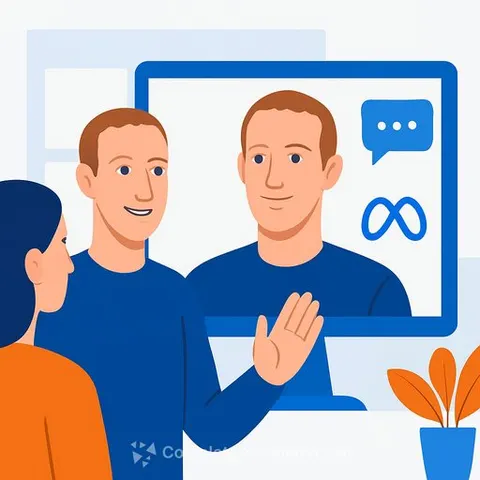
Meta Builds AI Version of Mark Zuckerberg for Employee Interactions
Meta is testing an internal AI system modeled on Mark Zuckerberg to interact with employees, extending the company's push to embed AI into workplace productivity. The system is trained on Zuckerberg's mannerisms, public statements, and strategic views, and will appear as a photorealistic 3D executive presence for internal communications and task delegation.
The project represents a shift from consumer-facing chatbots to operationally focused digital twins. Rather than a text-based assistant, Meta is building a multimodal system that combines large language models with speech and visual synthesis, trained on recorded mannerisms, public speeches, and corporate communications.
Technical challenges ahead
Creating a consistent executive digital twin involves three core problems. First, aligning text, audio, and visual behavior so the AI maintains a coherent persona across modalities. Second, managing latency and inference costs for photorealistic 3D rendering during live employee interactions. Third, building guardrails to prevent hallucination and ensure the system accurately represents leadership positions without inventing statements.
Meta has reported a 30% productivity boost for engineers using AI coding agents, signaling confidence in AI's workplace impact. The Zuckerberg digital twin extends this internal strategy to roles with social authority-a move that goes beyond code completion or document summarization.
Governance questions emerge
The experiment raises practical questions about consent, data provenance, and audit trails. Using personal recordings and mannerisms to train an AI system that speaks on behalf of an executive requires clear policies on who controls the output and how it's monitored.
Zuckerberg said earlier this year that 2026 would be the year AI begins to "dramatically change the way that we work." This digital twin is an early test of that vision at the executive level.
What comes next
Watch for Meta's disclosures on data sourcing, safety tooling for executive agents, and business metrics tied to the digital twin. The key question is whether this remains a controlled internal experiment or becomes a platform capability other leaders can deploy.
For strategy leaders, this signals how AI is moving from back-office automation into roles that require judgment and authority. The governance decisions Meta makes now will likely influence how other organizations approach similar systems.
Learn more about AI for Executives & Strategy and the technical foundations of generative AI and LLMs powering these systems.