Meta's AI Ambitions: A 2026 Roadmap and Boardroom Shift
Meta is accelerating its AI agenda with a clear 2026 plan while absorbing a sudden board change. The company is committing serious spend to infrastructure and signaling a more direct monetization path. A new federal AI order on December 11 is seen as constructive for long-term planning. Taken together, this sets expectations for bigger launches, bigger bills, and tighter execution.
What Meta plans to ship in 2026
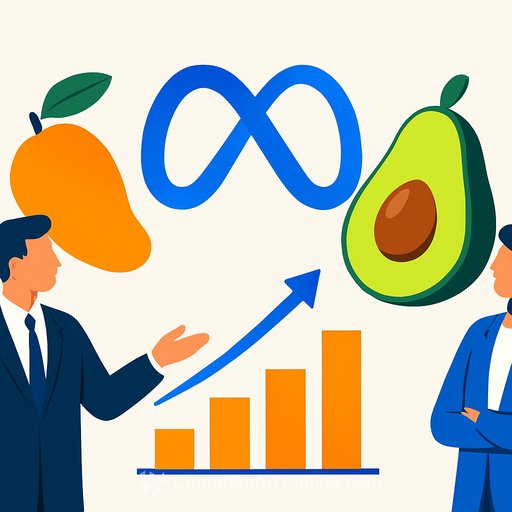
- Mango: A flagship model focused on image and video generation.
- Avocado: An advanced language model with stronger programming capabilities that integrates "World Model" research. Meta is considering paid access, a shift from past approaches.
This is a direct move to compete with OpenAI, Anthropic, and Google while testing willingness to pay for high-end language capabilities. Pricing and packaging for Avocado will be the tell.
Why this matters for strategy
- Product fit: Clear model roles help teams plan build-vs-buy decisions for creative, code, and agentic use cases.
- Monetization: Paid access to Avocado could change API budgeting and vendor mix for enterprises.
- Data and safety: "World Model" integration hints at more context-awareness. Expect stronger evaluation and governance requirements.
- Infrastructure: Rising capex points to compute and research velocity. Delivery timelines improve if supply chains hold.
Regulatory backdrop: fewer conflicts, more certainty
Analysts view the December 11 executive order establishing federal AI rules as constructive. A unified national framework reduces conflicting state rules and gives large platforms clearer ground to plan. Regulatory teams can accelerate compliance readiness via the AI Learning Path for Regulatory Affairs Specialists.
- NIST AI Risk Management Framework is a useful reference point for policy and controls.
Boardroom update: Dina Powell McCormick exits
Dina Powell McCormick resigned from Meta's Board of Directors effective immediately. She joined in April 2025 and may move into a strategic advisory role. Meta will not fill the seat; the board remains at 14 members, including UFC CEO Dana White and Broadcom CEO Hock Tan.
- SEC EDGAR company filings for official notices and governance updates.
The financial picture
Meta's market value sits near $1.67 trillion. Quarterly revenue grew 26% and operating margins are above 40%. Capex is projected at $70-$72 billion for 2025, with a significant increase expected in 2026. The next quarterly dividend of $0.525 per share is scheduled for December 23.
Street view
- Consensus average price target: ~$835.
- Wedbush: Outperform, cut from $920 to $880.
- Morgan Stanley: Overweight, cut from $820 to $750.
- Rosenblatt: Buy, $1,117 target.
Should investors sell or buy?
This comes down to conviction in 2026 delivery and the willingness of enterprises to pay for Avocado. If Meta ships on time and monetizes without eroding engagement or margins, the setup is favorable. Risks: model safety incidents, slower-than-expected monetization, and execution drag from capex scale. Near-term catalysts include detailed pricing, Mango/Avocado benchmarks, and updates on data center and silicon programs.
Actions for executives and strategy leaders
- Map 2026 capability bets to use cases: creative automation, code generation, agents, and multimodal workflows.
- Scenario plan for Avocado pricing: API budgets, workload routing, and vendor diversification.
- Tighten AI governance to align with federal guidance; adopt controls aligned to NIST and internal risk thresholds.
- Lock data strategy: access rights, synthetic data options, evaluation datasets, and red-teaming plans.
- Model Ops readiness: latency targets, cost ceilings, safety guardrails, and rollback procedures.
- Refresh infra assumptions: GPU/TPU availability, inference cost curves, and on-prem vs. cloud mix.
- Run controlled pilots on Mango/Avocado equivalents now to shorten time-to-production when Meta ships.
Key questions to pressure-test with your team
- Which high-ROI workflows benefit most from Mango vs. Avocado, and what's our TCO at scale?
- What's our fallback plan if paid access caps throughput or introduces usage constraints?
- How will we measure safety, bias, and regressions for multimodal and agentic tasks?
- What data partnerships or contracts are needed to train, fine-tune, and evaluate safely?
- What governance updates do we need to comply with federal rules while keeping delivery speed?
Get your teams AI-ready
If you're building capability maps, evaluation frameworks, or vendor strategies, structured training helps teams move faster. Explore role-based programs and company-specific tracks here:
Your membership also unlocks: