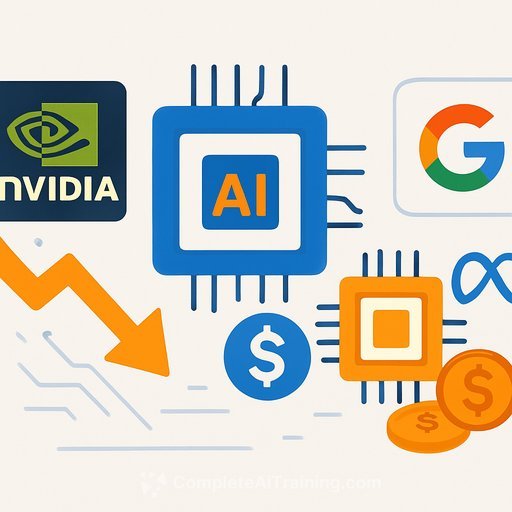
Meta's new AI chips raise the stakes for Nvidia and AMD - here's the finance angle
Meta introduced four in-house AI processors - MTIA 300, 400, 450, and 500 - to support everything from ranking and recommendations to high-end inference. The move lets Meta blend its own silicon with Nvidia and AMD hardware, easing vendor risk while pushing down unit costs over time.
The headline: MTIA 400 is the first Meta chip the company says delivers cost savings with raw performance competitive with leading commercial products. Meta also signed multiyear, multigenerational supply deals with Nvidia and AMD - a clear "both/and" strategy to secure capacity while building leverage.
What's new in the MTIA lineup
- MTIA 300: Targets core ranking and recommendations (R&R) workloads.
- MTIA 400: Built for generative AI and R&R. Can be deployed in a rack of 72 chips - conceptually similar to Nvidia's NVL72 or AMD's Helios racks. Meta claims cost savings and performance competitive with top commercial offerings.
- MTIA 450: Steps up with faster high-bandwidth memory (HBM) for higher throughput.
- MTIA 500: Adds more memory with even faster speeds for larger, memory-bound inference workloads.
- Rollout: Some chips are already in use; broader deployments land in 2026-2027. All share a common infrastructure so Meta can swap in upgrades without major rebuilds.
Why this matters for budgets and portfolios
Custom silicon is becoming standard for hyperscalers. Google and Amazon have long trained and served models on their own chips, rent that capacity to Anthropic, and Microsoft now has the Maia 200. A reported multibillion-dollar deal will also see Meta use Google's processors - another sign diversified compute is the new default.
For suppliers, there's risk and resilience. Nvidia said slightly more than 50% of data center revenue comes from hyperscalers, but growth is also coming from the rest of the market. Meanwhile, hyperscaler capex isn't cooling: Amazon, Google, Meta, and Microsoft plan to spend a combined $650 billion in 2026, with most of it flowing into AI infrastructure.
Implications to price into your models
- Nvidia and AMD near term: Still strong, supported by multi-year contracts and expanding non-hyperscaler demand. Supply remains tight in premium tiers.
- Medium term: As in-house chips mature, expect more workload-specific offload from commercial GPUs. That can pressure pricing and mix even if absolute unit demand stays high.
- Meta's TCO path: If MTIA 400/450/500 hit claimed cost and performance targets, Meta can lower cost-per-inference for R&R and targeted genAI tasks. The shared infrastructure cuts swap costs and shortens upgrade cycles.
- Ecosystem effect: Similar rack-scale approaches (e.g., NVL72/Helios) suggest tighter integration of compute, memory, and networking. The bottleneck to watch is HBM supply and power density at the rack level.
What to watch next
- Deployment cadence: Concrete milestones for 2026-2027 rollouts, plus any public benchmarks against Nvidia/AMD in R&R and inference.
- Unit economics: Cost-per-token (genAI) and cost-per-inference (R&R) versus leading GPUs; rack-level power, cooling, and utilization.
- Vendor mix: How Meta splits future capacity across Nvidia, AMD, MTIA, and the reported Google processor deal.
- Supply constraints: HBM availability and lead times; any signs of networking or substrate bottlenecks.
- Capex trajectory: Are the Big Four tracking to the $650B figure, and how much is earmarked for in-house versus third-party silicon.
Practical takeaways for finance leaders
- Hedge vendor risk: Structure capacity plans with multi-vendor coverage - mix premium GPUs for frontier models with in-house or alternative accelerators for targeted inference.
- TCO beats peak TFLOPS: Compare full-stack costs (hardware, power, networking, software, utilization) on a per-workload basis. Lock negotiated price/mix tiers tied to delivery windows.
- Prioritize portability: Favor architectures that let you swap accelerators without refactoring your stack. Meta's shared MTIA infrastructure is a signal: flexibility saves money.
- Stage-gate large buys: Phase orders around performance data and power/floor readiness. Tie payments to acceptance criteria like sustained throughput, thermal envelopes, and SLA-backed availability.
- Track hyperscaler disclosures: Watch for utilization rates, inference share of workloads, and changes in procurement timing that can move margins and cash flow.
If you're planning or reviewing AI infrastructure budgets, see the AI Learning Path for CFOs for frameworks that support scenario planning, unit-economics modeling, and risk controls.
Your membership also unlocks: