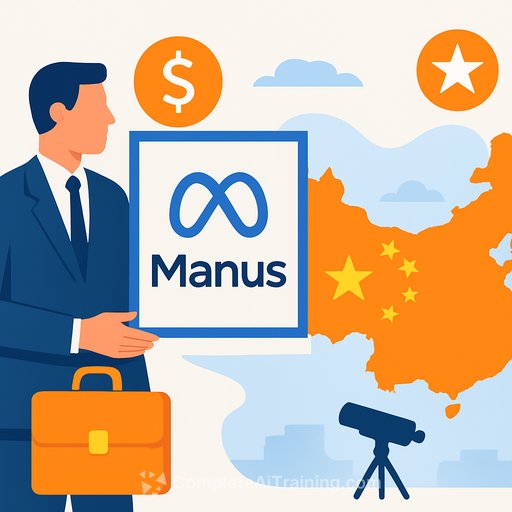
China Reviews Meta's $2B Purchase of AI Start-up Manus Over Tech Transfer Rules
China's Ministry of Commerce is reviewing Meta's acquisition of Manus, a Chinese AI start-up, for potential breaches of technology control linked to asset and talent transfers. The deal, completed in December, is valued at $2 billion (around Rp33.5 trillion).
Officials are examining whether moving Manus staff and core technology to Singapore requires a formal export license under Chinese law. The focus is clear: prevent sensitive AI capabilities from leaving the country without approval and uphold data sovereignty requirements.
Why this matters for government officials
Cross-border AI deals now trigger export control, data governance, and security reviews by default. The Manus case is a template: a high-profile acquisition, relocation of engineers and models, and questions about who controls datasets, training pipelines, and deployment rights.
What Beijing is assessing
- Whether Manus technologies qualify as "sensitive" and need export permits before transfer to a foreign entity or offshore hub.
- If staff relocation effectively exports know-how (weights, model architectures, agent frameworks, and operational playbooks).
- Compliance with data sovereignty rules tied to Chinese-origin data, checkpoints, and audit trails.
Possible outcomes
- No action if controls are deemed unnecessary.
- Conditional approval with licensing, ring-fencing of assets, or local operating requirements.
- Intervention or cancellation if authorities find unlicensed transfers or material national-security concerns.
About Manus' tech
Manus is known for an AI agent that can plan and execute complex tasks with minimal human input. Industry coverage has described its performance as well beyond typical chatbot behavior seen with tools like ChatGPT or Deepseek.
Signals for public-sector procurement and policy
- Treat AI agents as controlled tech: Assume model weights, fine-tuning data, and orchestration frameworks may fall under export or cybersecurity rules.
- Map staff transfers: Track where key engineers work, where code is hosted, and who has access to models and datasets.
- Use licensing guardrails: Require vendors to show export permits and data-residency controls before contract award.
- Audit data lineage: Verify origin, consent, and lawful basis for any Chinese-origin data used in training or inference.
- Plan for reversibility: Include clauses that allow service continuity if a deal is delayed, conditioned, or blocked.
Action checklist for agencies and SOEs
- Request an export-control attestation and evidence of permits for any China-sourced tech or staff relocation.
- Demand a data map: storage locations, access controls, residency, and cross-border transfer mechanisms.
- Include escrow or on-prem fallback options in contracts for critical workflows.
- Establish incident reporting if regulators impose new conditions post-closing.
Current status
The review is in its early phase. Neither Meta nor Manus has provided public comment. Outcomes will hinge on whether the move to Singapore constitutes an export of sensitive technology and whether data sovereignty safeguards are verifiably in place.
Context and resources
- Ministry of Commerce of the People's Republic of China (MOFCOM)
- Financial Times coverage of China tech and export controls
- Complete AI Training - Courses by Job (policy, governance, risk)
Your membership also unlocks: