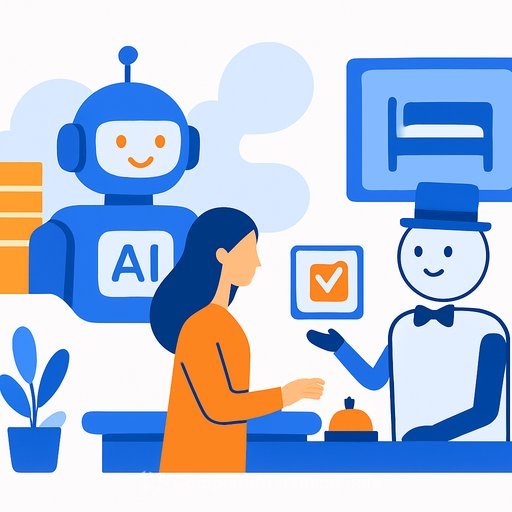
Mews Raises $300M to Put AI in Charge of Hotel Operations
Mews has secured $300 million in new funding at a $2.5 billion valuation to build AI agents that run core hotel operations. The bet is clear: move beyond guest-facing chat and let software make day-to-day operational decisions. The catch is the same one every ops leader knows-legacy systems won't cut it.
Founder Richard Valtr and CEO Matt Welle are pushing what they call "agentic orchestration," where AI coordinates pricing, staffing, housekeeping, and guest requests across systems with minimal human touch. If hotels adopt it, front desks run leaner, teams switch from task-doing to exception-handling, and revenue rules update themselves.
The Raise, at a Glance
The Series D doubles Mews' valuation from $1.2 billion in March 2024. The company says it will channel the capital into three priorities: deeper agent-driven AI across analytics, revenue, and operations; tighter fintech integrations so payments and cash flow become native to workflows; and faster expansion in North America and Europe.
What Mews Is Building
Short term: AI co-pilots that recommend actions across revenue management, ops, and analytics. That includes expanding tools like Smart Tips and Atomize (acquired in 2024) to inform rates, staffing, and service tasks.
Longer term: autonomous agents that receive a guest request, dispatch it to the right team, and verify completion-no manual routing. This hinges on standardized data and reliable integrations across systems, a push accelerated by the DataChat acquisition in October 2025.
Why This Matters for Operations Leaders
- Staffing leverage: shift headcount from repetitive tasks to high-value service and exceptions.
- Revenue agility: continuous pricing and packaging updates based on demand, inventory, and guest behavior.
- Fewer swivel-chair workflows: agents coordinate across PMS, RMS, housekeeping, and payments.
- Decision transparency: set rules, thresholds, and approvals so autonomy never exceeds your guardrails.
Roadmap and Adoption Path
Welle says the company will scale tools already in market first, then introduce co-pilots in 2026, before moving to more autonomous agents as customers build trust. Expect "clearly defined limits" at each stage-think configurable scopes, approval flows, and audit logs.
The real unlock is clean, consistent data. Without standardization across PMS, RMS, housekeeping, and payment systems, autonomy stalls. With it, agents can make reliable decisions and close the loop on tasks.
Scale and M&A Foundation
Mews has used capital to buy capabilities across housekeeping automation, revenue management, and AI infrastructure. It now reports roughly 15,000 customers and 132,000 monthly active hoteliers across 85 countries. In 2024, it processed $19.7 billion in platform transaction volume-evidence that payments and operations are already intertwined.
Funding History
- 2018: ~$7M Series A
- 2019: $33M Series B
- 2022: $185M Series C
- 2024: $110M funding round
- 2024: $100M credit facility
- 2025: $75M growth round
- 2026: $300M Series D
Total raised since 2016: $900M+.
Risks and Open Questions
- Legacy drag: can properties migrate fast enough to cloud-native, API-first systems to support autonomy?
- Operator trust: how much decision-making will teams hand to algorithms-and what proof do they need?
- Feature creep: as Mews adds products, do hotels feel orchestration or just another layer to manage?
- Controls and compliance: payments, data privacy, and auditability must be built in from day one.
Action Checklist for Hotel Ops Leaders
- Inventory your stack: list core systems (PMS, RMS, housekeeping, POS, payments) and identify gaps in APIs and data standards.
- Define guardrails: set approval thresholds for rates, upgrades, comps, overbooking buffers, and service-level commitments.
- Pilot with scope: start with one property or one function (e.g., rate updates or housekeeping dispatch) and track clear KPIs.
- Wire in payments: tie authorization, reconciliation, and refunds to operational triggers to cut leakage and chargebacks.
- Train for exceptions: teach staff how to intervene, override, and audit-this is oversight, not micromanagement.
- Measure weekly: time-to-assign, time-to-complete, forecast accuracy, RevPAR impact, labor hours saved, and guest NPS on service recovery.
Bottom Line
The tech exists. The question is operational will: are you ready to let software make routine decisions at scale, with clear controls? If yes, you get speed, consistency, and a team freed up to deliver moments guests remember.
For a primer on agent-led systems, see autonomous agents. If you are building capability across your team, explore practical learning paths by role: AI Learning Path for CIOs, AI Learning Path for Technology Managers, and AI Learning Path for Software Engineers.
Your membership also unlocks: