Michael Lewis vs. ChatGPT: The write-off that could define 2026
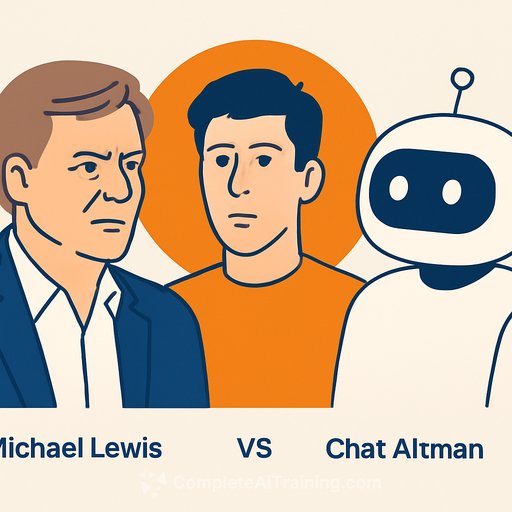
Michael Lewis has a verbal agreement with Sam Altman to write Altman's biography-with a catch. He'll only do it when ChatGPT can produce a competing draft from the same source material. Then they'll run a head-to-head contest and see which book wins.
For writers, that's the signal. The bar is moving. The job shifts from typing words to producing work an AI can't replicate: access, taste, structure, and stakes.
The deal, with a twist
Lewis met Altman while researching Going Infinite, his book on Sam Bankman-Fried. He joked that if Altman's AI is so smart, it should write the biography. Altman's response: "It'd be a really bad book"-for now. Asked when it might be good, Altman guessed "maybe a couple of years."
Hence the challenge. When both agree the model is finally "good," they'll pour everything in-emails, Slack, data-and let the model write its book while Lewis writes his. Then compare.
Altman as a character
Altman helped kick off the current era of AI with ChatGPT in late 2022, then was fired and rehired over one weekend. He's been sued by Elon Musk and sits at the center of hype, fear, and massive expectations.
That's the kind of character Lewis turns into story: high agency, big bets, conflicting motives. Hollywood has loved that formula since Moneyball and The Big Short.
What's already on the shelf
Several books on Altman and OpenAI exist, including Keach Hagey's The Optimist and Karen Hao's Empire of AI. In the New York Times, Tim Wu reviewed both together, asking which portrait captures the "real" Altman and invoking the classic "paperclip problem."
AI is productive. Markets are messy. Winners won't be uniform.
At the same event, Tom Lee argued that shrinking tech employment and higher jobless rates for recent college grads point to rising productivity. Companies are also spending less on traditional software as agentic AI replaces parts of it. He sees 2026 as the point where the payoff becomes obvious-and uneven.
Lewis agreed on the uneven part. Big tech shifts don't guarantee big profits for every company. Some bets fly; others crash.
The craft edge (for now)
Lewis tried letting AI "write a book" about Bankman-Fried. The result read like stitched web summaries-no original reporting, no smell of the room, no human tension. He doesn't feel threatened by that sort of output yet.
He's more uneasy about industry leaders who say, in the same breath, that AI could "kill us all" and also do everything a human can do "in 18 months." If that second claim lands, social blowback will be brutal. Writers should plan for both scenarios: incremental assist or sudden capability jump.
A useful history lesson
Lee pointed to "flash-frozen" food in the 1920s: farming dropped from up to 40% of the workforce to a few percent, yet new jobs emerged and the economy adapted. Contrast that with the 1990s offshoring wave that gutted entire regions with little plan for transitions.
The takeaway: progress can lift living standards, but the transition is where people get hurt. For writers, that transition is now.
What writers can do now
- Compete on access: interviews, off-record conversations, source graphs, field reporting. AI can't walk into a room or earn trust.
- Build living dossiers: timelines, characters, claims, receipts. Keep notes structured so you can move fast when a story breaks.
- Use AI for grunt work: transcript clean-up, summaries, idea lists, sensitivity checks, alt headlines. Keep your voice human and specific.
- Write what models miss: sensory detail, scene work, moral tension, surprising structure. Make choices a prediction engine won't make.
- Quant + quotes: mix data with reporting. Verify numbers, call two more sources than feels necessary, and print the uncertainty.
- Test "AI vs. you" formats: publish your version, then share what the model missed. Readers learn to trust the delta.
- Own distribution: newsletter, SMS list, and a direct feedback loop. Don't let algorithms be your only gatekeeper.
- Protect your sources and IP: avoid dumping private materials into third-party tools without safeguards or written consent.
- Price outcomes, not word counts: retainers tied to conversions, subscribers, or read-through beat commodity rates.
- Scenario-plan for 2026: if models write a "good book," your moat is access, taste, legal risk-taking, and narrative ambition.
Practical tools for your stack
- Research sprint: have AI produce competing outlines and counterarguments before you write. It surfaces blind spots fast.
- Editing pass: ask for rhythm checks, cliché detection, and line-level tighten-ups-then finish by ear.
- Packaging: generate 10 headlines, 10 dek options, and 3 angles; choose the one that fits your positioning.
- Ethics check: prompt for conflicts, untested claims, and potential legal risks to flag before publishing.
Keep your edge sharp
Lewis's bet is clear: when AI can write a "good" book, the writer who still wins will have relationships, taste, and scenes that no dataset can fake. If you build that now, you're hard to replace-even if models improve on schedule.
If you want structured ways to fold AI into your writing workflow without losing your voice, explore these resources:
Your membership also unlocks: