Microchip expands full-stack tools to speed up Edge AI development
Microchip Technology has rolled out a new set of full-stack solutions to make on-device AI faster to build and easier to ship. The stack layers software, pre-trained models, and development tools onto its MCU and MPU platforms so teams can deliver secure, energy-efficient inference next to the sensor. That matters in industrial, automotive, and consumer systems where real-time response and tight power budgets are non-negotiable.
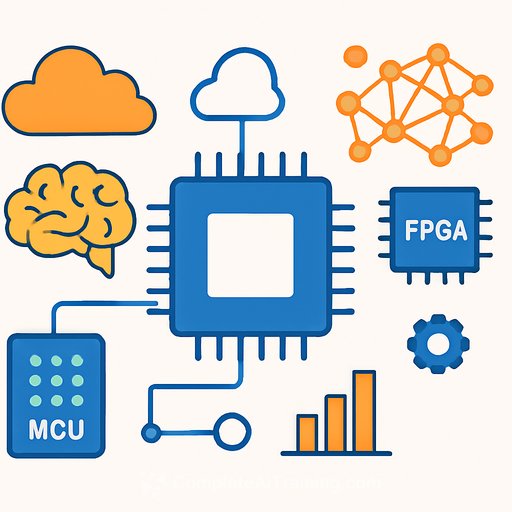
Edge AI isn't a pilot project anymore-it's table stakes. Microchip's Edge AI business unit brings together MCUs, MPUs, and FPGAs with optimized ML models, acceleration paths, and developer tooling to reduce build time and risk for production deployments in demanding markets, said Mark Reiten, corporate vice president of the company's Edge AI business.
What's in the stack
The new offering includes pre-trained models and adaptable application code that can be modified with Microchip's embedded software suites or partner tools. Early application solutions target high-value, production-ready use cases:
- AI-based detection and classification of electrical arc faults
- Predictive maintenance via condition monitoring
- On-device facial recognition with liveness detection
- Keyword spotting for voice interfaces across consumer, industrial, and automotive
Workflow on MCUs and MPUs
Microchip's MPLAB X IDE, paired with the Harmony framework and the ML Development Suite plug-in, gives developers a single flow for embedding optimized models. Teams can start with quick proofs of concept on 8-bit MCUs, then move up to 16- and 32-bit devices as models, memory, and latency needs grow. Learn more about MPLAB X IDE.
Acceleration on FPGAs and system building blocks
For FPGA projects, the VectorBlox Accelerator SDK 2.0 supports vision processing, human-machine interfaces, and sensor analytics, plus model training, simulation, and optimization. Microchip also provides training resources like motor-control reference designs on dsPIC digital signal controllers and tools for smart metering, surveillance, and object detection. Complementary parts-PCIe connectivity devices and high-density power modules-help support edge AI loads in industrial automation and even data-center gateways.
Why this matters for engineering teams
A 2025 report from analyst firm IoT Analytics points to MCU-level AI as a key trend: bringing models closer to the data cuts latency, improves privacy, and reduces dependence on the cloud. Microchip's update fits that shift, offering both software-driven and hardware-assisted acceleration across multiple device and memory profiles. See market context from IoT Analytics.
How to put it to work
- Pick a contained use case (e.g., arc-fault detection or keyword spotting) and set clear latency, accuracy, and power targets.
- Start with a pre-trained model and sample app in MPLAB X + Harmony; validate on an 8-bit MCU to prove feasibility fast.
- Profile memory and timing, then decide whether to stay on MCU, step up to a 16/32-bit device, or offload heavy kernels to an FPGA via VectorBlox.
- Customize models with the ML Development Suite or partner tools and retrain with data from your environment.
- Leverage reference designs (motor control, metering, surveillance) to shorten bring-up and reduce integration risk.
If you're leveling up your edge ML skills, browse curated learning paths such as AI Learning Path for Plant Managers, AI Learning Path for Production Planners, and AI Learning Path for Supply Chain Analysts.
Your membership also unlocks: