Microsoft and NVIDIA Deploy AI Tools to Speed Up Nuclear Plant Construction
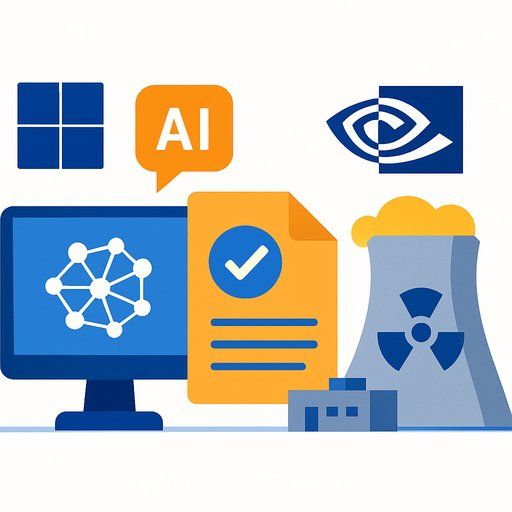
Microsoft and NVIDIA are releasing an AI-powered toolkit designed to compress the permitting, design, and engineering timelines that have made building new U.S. nuclear plants prohibitively slow and expensive. Early adopter Aalo Atomics reported a 92% reduction in permitting timelines and estimated annual savings of $80 million.
The collaboration addresses a concrete problem. Georgia's Plant Vogtle, the most recent U.S. reactor to come online, took 15 years and $35 billion to complete - the costliest infrastructure project in American history. Regulatory bottlenecks, bespoke engineering processes, and lengthy approval cycles have effectively stalled nuclear development.
Big Tech faces mounting energy demands from data centers. As artificial intelligence workloads grow, so does power consumption. Nuclear is increasingly viewed as the only energy source that can scale to meet that demand without relying on fossil fuels.
How the Toolkit Works
The system combines generative AI and digital twins to streamline reactor design and regulatory approval. Generative AI handles document drafting and gap analysis for licensing. Advanced simulations - including 4D models that track time and 5D models that track costs - allow teams to virtually construct plants before construction begins.
These aren't theoretical improvements. Microsoft says Aalo Atomics is already deploying the toolkit at scale. The company cut permitting timelines by 92%, translating to roughly $80 million in annual savings.
"Two things matter most: enterprise-scale complexity and mission-critical reliability," said Yasir Arafat, CTO of Aalo Atomics. "We're deploying something complex at a scale only a company like Microsoft really understands."
Idaho National Lab is also testing the toolkit. Both organizations serve as proof points that digitizing nuclear development can reduce delays.
Why This Matters for Development Teams
AI tools built for IT and development environments are now being applied to infrastructure problems. The toolkit demonstrates how enterprise-scale AI systems handle mission-critical workflows - document generation, design iteration, compliance checking, and cost modeling.
For development professionals, the lesson is practical: AI can compress timelines in domains where regulatory approval and iterative design have historically created bottlenecks. The same principles apply beyond nuclear - permitting, compliance, and design workflows in other sectors face similar constraints.
The Broader Energy Race
Microsoft and NVIDIA are also investing in nuclear fusion, betting that AI can accelerate breakthroughs in that space. Both companies view nuclear - whether fission or fusion - as essential to sustaining AI infrastructure growth without increasing carbon emissions.
The toolkit rollout signals that Big Tech sees nuclear development as solvable through engineering and digitization, not policy change alone. Whether that bet pays off will determine whether the nuclear sector can actually keep pace with data center energy demand.
Your membership also unlocks: