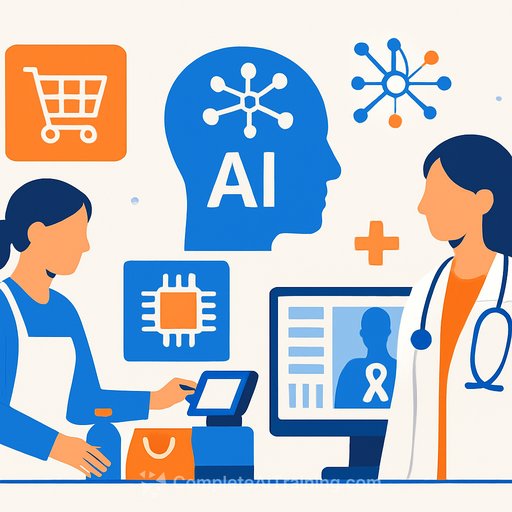
Microsoft Pushes Applied AI Deeper Into Healthcare Workflows
Microsoft is moving beyond AI demos and putting its stack inside core healthcare workflows. The headline items: Bristol Myers Squibb is partnering with Microsoft on AI health infrastructure for early cancer detection, and Microsoft's Precision Imaging Network uses FDA-cleared algorithms across a network that already reaches most U.S. hospitals. On the surface, it's a tech update. In practice, it's a push to make Azure and Copilot part of clinical operations.
In parallel, Microsoft launched Copilot Checkout with partners like PayPal, Shopify, and Stripe in retail, and it signed a new Azure and AI agreement with Mercedes-AMG PETRONAS F1. Different markets, same strategy: embed AI where people actually work, transact, and make decisions-then scale.
Why this matters for healthcare teams
Microsoft isn't pitching stand-alone tools. It's aiming for the workflow layer-imaging, pathway orchestration, and operational systems that clinicians and staff touch every day. That has real implications for safety, compliance, uptime, and cost control.
- Earlier detection, tighter workflows: Bristol Myers Squibb's work with Microsoft signals more AI at the front of oncology pathways. Through the Precision Imaging Network and FDA-cleared models, expect more structured handoffs from detection to diagnosis to treatment planning.
- Imaging reach at scale: The Precision Imaging Network already connects a large share of U.S. hospitals via existing radiology infrastructure, reducing context switching and speeding up deployment across sites.
- Operational proof points: The Mercedes-AMG PETRONAS F1 deal showcases Azure in high-performance environments. Different field, same lesson for healthcare: reliability, latency, version control, and monitoring need to be dialed in.
- Signals from retail: Copilot Checkout shows how Microsoft is embedding AI at the point of transaction. The pattern applies to patient payments, prior auth, and revenue cycle touchpoints where small gains compound.
What to watch next
- Provider adoption: How quickly health systems use the Precision Imaging Network for lung cancer pathways, and whether usage expands to other modalities.
- Real-world performance: Measurable outcomes such as time-to-report, nodule detection sensitivity/specificity, and downstream treatment timelines.
- Interoperability in practice: Clean integration with DICOM/DICOMweb and FHIR assets, plus minimal disruption to existing RIS/PACS and EHR workflows.
- Pricing and consumption: Transparent costs for inference, storage, and data movement. Watch for unit economics that hold up beyond pilot sites.
- Adjacent agreements: Similar AI-centric partnerships in cardiology, pathology, and population health would point to a broader rollout.
Risks to manage
- Clinical risk and validation: Bias, model drift, and edge cases. Independent validation and ongoing QA are non-negotiable.
- Privacy and governance: PHI handling, data residency, clear BAAs, and documented access controls.
- Operational resilience: Uptime SLAs, incident response playbooks, version pinning, and rollback paths for models and prompts.
- Vendor lock-in: Exit plans, portable data formats, and clear rights over derived datasets and model outputs.
- Regulatory exposure: Audit trails for algorithm use, human-in-the-loop checkpoints, and alignment with FDA expectations for AI/ML SaMD.
Practical next steps for health systems and life sciences teams
- Map the pathway: Identify where AI could reduce time-to-diagnosis in lung cancer (triage, nodule detection, follow-up scheduling). Pick one pathway and one metric to move first.
- Pilot with guardrails: Run a 60-90 day pilot on a limited site list. Track sensitivity/specificity, turnaround time, and escalation rates. Keep a human in the loop.
- Build oversight early: Set up monitoring for drift, lineage, and audit logs. Establish a clinical review committee for model changes and prompt updates.
- Contract for resilience: Lock in BAAs, uptime SLAs, latency targets, and exit clauses. Clarify data use rights, especially for fine-tuning and analytics.
- Train the team: Short sessions for radiologists, oncologists, and imaging ops on workflow changes, fail-safes, and expectations.
Context and resources
For background on the imaging network and regulatory posture, these are helpful starting points:
Upskilling your team
If you're planning pilots or building an internal AI working group, a structured learning path speeds up execution and reduces risk.
- AI Learning Path for Training & Development Managers - a focused pathway to help managers oversee pilots, governance, and team readiness.
Note: This is general commentary for healthcare professionals. It's not financial advice or clinical guidance.
Your membership also unlocks: