Microsoft's $7.5B AI push turns up the heat on insurer model risk
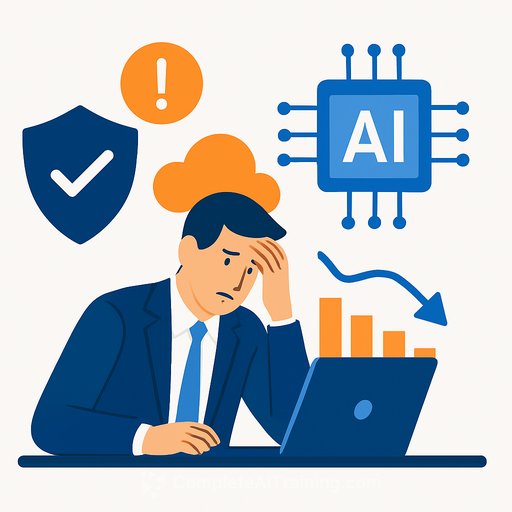
Microsoft's new $7.5 billion commitment to expand Canada's AI capacity over the next two years (part of $19 billion planned through 2027) is a clear signal: AI adoption is scaling across clients, vendors, and carriers at high speed. The upside is obvious-faster decisions, richer data, and new products. The risk is quieter and compounding.
As AM Best's Sridhar Manyem put it: "AI is ready, but are we ready?" For insurance leaders, the answer rests on whether data, models, and operations can hold up under new attack surfaces, cloud concentration, and regulatory expectations.
The risk picture: bigger, faster, more correlated
Many carriers are layering advanced models on top of fragmented, legacy data. That makes model build and validation shaky from the start. The result: brittle decisions, hard-to-explain outcomes, and unreliable performance when conditions shift.
- Data sprawl and inconsistency: Separate systems for claims, underwriting, policies, and regulatory reporting make training and validation difficult. Years of unstandardized data are working against you.
- Climate non-stationarity: Historic loss data no longer maps cleanly to current exposures. Drift is real, and it compounds.
- Data/model poisoning: Bad actors can seed corrupt data that slowly skews outputs-risk scores, fraud flags, or auto-underwriting-without tripping obvious alarms. "You need to make sure that the data you're using is protected and that you don't let any bad actors into the system," Manyem warned.
- Deepfakes and synthetic fraud: Cheap, convincing content stretches claims and SIU workflows. Traditional controls weren't built for this.
- Cloud dependency and concentration: Fewer platforms, more automation, and reduced headcount increase the blast radius of any outage. One disruption can ripple across carriers and insureds at once.
- Opaque models and weak challenge: If only a small group understands how a model behaves, governance is theatre, not control.
What to do in the next 90 days
- Map your data lineage: Inventory critical data sets feeding AI/ML. Document owners, sources, sensitivity, quality scores, and retention rules. Fix duplicates and reconcile definitions used by underwriting, claims, and finance.
- Lock down the training pipeline: Isolate training environments. Enforce read/write permissions, cryptographic signing of datasets, and checksums to detect tampering. Add canary data to spot poisoning.
- Stand up model governance that actually bites: Create a model registry, approval gates, challenger models, and stress tests. Require clear model cards: purpose, inputs, limits, drift thresholds, escalation paths.
- Red-team your AI: Test for prompt injection, data leakage, and adversarial inputs. Validate deepfake detectors in claims and SIU workflows.
- Run a cloud outage tabletop: Assume a multi-hour disruption of a primary provider. Who approves fallback? What manual workarounds exist? How do you notify brokers, MGAs, and policyholders?
- Quantify concentration risk: Map exposure to specific clouds, regions, and proprietary AI services across underwriting, rating, distribution, and claims. Set hard limits and diversify where feasible.
Underwriting and product implications
- Cyber: Update threat models to include data poisoning of client systems, synthetic fraud, and model theft. Revisit controls questionnaires to test vendor/AI supply chain risks and training data protections.
- Property/BI: Treat cloud failure as a correlated peril. Assess whether wordings, sub-limits, or exclusions reflect current systemic exposure from AI-dependent operations.
- D&O and E&O: Consider disclosure risk around AI use, explainability gaps, and model governance. Poor oversight will look like negligence after an incident.
- Claims: Build playbooks for deepfake evidence, voice cloning, and synthetic identities. Define thresholds for expert review and tools for media forensics.
Data quality: fix the foundation before you scale
Consolidate critical data for underwriting, pricing, and claims into defined, monitored pipelines. Standardize schemas and reference data. Set measurable quality targets-freshness, completeness, bias checks-and gate model promotion on those metrics.
If a model can't be explained in plain language to frontline teams and the board, it isn't production-ready. Accuracy without oversight is a liability.
Cloud concentration: treat it like a systemic peril
Manyem warned that aggressive automation tied to a few hyperscale providers can snap under stress. Model build, training, inference, and orchestration often sit on the same stack. That's a single point of failure.
- Diversify compute where it counts: Separate vendors or regions for training vs. inference. Keep warm failover paths for critical workflows.
- Contract for exit and surge: Pre-negotiate burst capacity, data egress, and alternative deployment options. Test them, don't just file them.
- Monitor correlated exposure: Ask large commercial clients about their AI/cloud dependencies. Your portfolio risk depends on theirs.
What regulators and boards will expect
Expect more scrutiny of explainability, data rights, and security across the AI lifecycle. Canada's proposed Artificial Intelligence and Data Act (AIDA) points to accountability for high-impact systems and responsible data use. Boards should treat AI as conduct, compliance, and reputational risk-not a side project.
KPIs that keep you honest
- Model drift rate: Frequency and magnitude of performance degradation vs. baseline.
- Data quality SLA adherence: % of datasets meeting freshness/completeness thresholds.
- Time-to-detect poisoning anomalies: From injection to quarantine.
- Cloud dependency index: % of critical workflows reliant on a single provider/region.
- Human-in-the-loop coverage: Share of high-stakes decisions with documented review.
Bottom line
The sector is buying speed with hidden correlation. The controls you had for traditional IT won't carry the load for AI-driven operations. Treat data integrity, model governance, and cloud concentration as balance-sheet risks-and move now, before loss events force the issue.
Practical next step
If your teams need structured upskilling in AI use, risk, and workflow design, explore role-based training options here: Complete AI Training - Courses by Job. Build capability, then scale with control.
Your membership also unlocks: