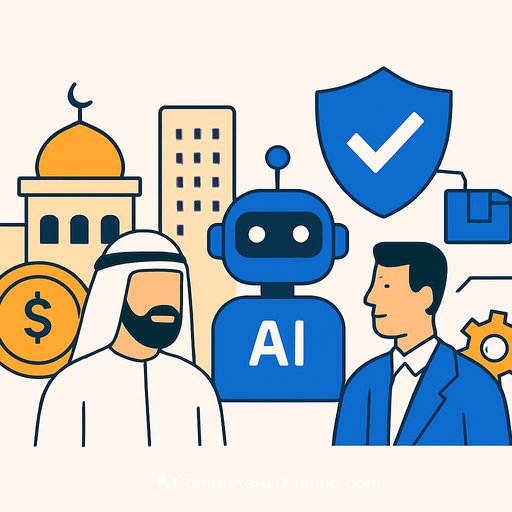
Middle East finance puts AI agent and supply chain security first
Banks and FinTechs across the Middle East are putting AI agents to work in customer service, fraud, and risk. As projects move from pilots to production, security is the headline item on every roadmap.
Cisco's AI Readiness Index 2025 signals the trend: more than 90% of organisations in the UAE and Saudi Arabia plan to build or deploy AI agents. That pace brings clear benefits-and tighter requirements for controls, auditability, and trust.
Why AI agents raise new risks
Agents touch sensitive data and can trigger actions on core systems. If an attacker redirects prompts, poisons inputs, or exploits a weak integration, the fallout can be financial loss, regulatory exposure, and brand damage.
The bigger risk sits upstream: the AI supply chain. Models, datasets, embeddings, and frameworks often come from third parties or open source. One tainted model or dataset can ripple through many products.
Where exposure shows up
- Model or dataset poisoning that leads to incorrect decisions or hidden backdoors
- Prompt injection that pushes agents to reveal data or run risky tools
- Data leakage through logs, vector stores, or poorly scoped connectors
- Denial-of-service on model endpoints and context windows
- Over-permissioned tools that let agents move money, change limits, or edit KYC records without oversight
- Harmful or non-compliant outputs that breach policy or regulation
What good looks like: security by design for AI
- Asset inventory: track models, datasets, prompts, plugins, connectors, and where they run
- AI SBOM/MBOM: maintain a bill of materials for each agent (models, versions, sources, licenses)
- Supply chain vetting: source models and data from trusted providers; validate signatures and hashes
- Pre-deployment scanning: check models, containers, and repos for known issues and unsafe behaviors
- Dataset governance: document lineage, consent, PII handling, and retention
- Evaluations and red-teaming: test for jailbreaks, bias, policy breaks, and tool misuse before go-live
- Runtime protection: use LLM firewalls/guards, content filters, and rate limits; sanitize prompts and tool outputs
- Least privilege: scope agent access to the minimum set of tools, data, and transactions; rotate secrets
- Human-in-the-loop: require approvals for high-risk actions (payments, credit decisions, AML alerts)
- Observability: log prompts, tool calls, and outputs; monitor drift, latency, and error rates
- Incident response for AI: playbooks for model rollback, key rotation, user notification, and regulator updates
- Compliance mapping: align controls to regional banking and insurance regulations - consider the AI Learning Path for Regulatory Affairs Specialists for practical compliance and monitoring guidance
Agentic and multi-agent systems: more capability, more moving parts
As teams connect agents to CRMs, payment rails, document systems, and risk tools, the surface grows. Multi-agent workflows introduce handoffs that need guardrails, audit trails, and clear ownership.
Put gates between agents and high-impact tools, and isolate environments so a fault in one agent doesn't cascade into core banking systems.
Governance and people
Policy beats improvisation. Adopt a clear model risk and AI governance framework, and make it actionable for product, risk, and engineering teams. The NIST AI Risk Management Framework is a useful starting point, and the OWASP Top 10 for LLM Applications helps prioritize technical controls.
Upskill teams on secure prompt design, data protection, evaluation methods, and incident response. Finance leaders should set KPIs for model quality, override rates, loss events, and control coverage so progress is visible - see the AI Learning Path for Vice Presidents of Finance for role-focused governance and risk practices.
Vendor and partner due diligence
- What models and datasets are used? How are they versioned and validated?
- How is PII handled across prompts, logs, and vector stores? Can you keep data residency?
- Which runtime protections are in place (filters, rate limits, tool isolation)?
- How are incidents reported, and what is the rollback plan?
- What third parties sit in the path, and how are they monitored?
Outlook for Middle East finance
Expect continued AI adoption across digital banking, credit risk, AML, and advisory. The firms that win will pair speed with security, controls, and clear lines of accountability.
"As AI agents move from experimentation to real-world deployment across the Middle East, organisations are facing new security considerations. From the third-party components used to build AI systems, to how autonomous agents interact with data and tools, securing the full AI lifecycle is becoming increasingly important for maintaining digital trust and resilience."
Make security a default, monitor continuously, and keep humans in the loop for critical decisions. That's how you protect customers, meet regulators' expectations, and ship useful AI-without surprises.
Next step
If you're building internal capability, explore practical upskilling paths for finance, risk, and operations teams at Complete AI Training - courses by job.
Your membership also unlocks: