
AI news ·
Middlebury professors turn to blue books as AI use among students rises
Colleges are returning to handwritten blue book exams as professors abandon take-home work to curb AI-assisted cheating. A survey found 65% of students at one school self-reported breaking the honor code.
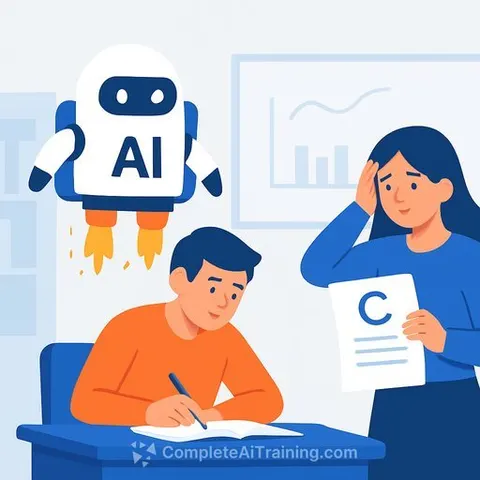
Blue Books Remain Standard as Professors Respond to AI in Classrooms
Three and a half years after ChatGPT's launch, colleges are seeing a shift back toward in-class handwritten exams. Professors report that the rise of large language models has prompted many colleagues to abandon take-home assignments and switch to blue book exams, particularly in introductory courses.
A recent survey found that 65% of students at one institution self-reported breaking the honor code, reflecting concerns about AI-assisted cheating.
Why Professors Are Holding the Line
Assistant Professor of Political Science Caleigh Glenn decided against allowing AI use in her courses, despite initially considering a qualified policy. She views writing as thinking-a process students must work through themselves, not outsource to tools.
"Writing is hard," Glenn said. "It's hard to sit down in front of a blank piece of paper and come up with an idea and come up with a nice way of putting it all together. That's the process of writing."
Glenn assesses students through a mix of blue-book exams and shorter at-home writing assignments to evaluate both knowledge and skills.
Matthew Dickinson, a professor of political science, has administered in-class blue book exams for over 25 years and sees no reason to change. He notes that the value has always been straightforward: "It rewards students who have put in the effort to attend lectures and engage in careful reading of course materials."
Dickinson reports that many colleagues have moved away from take-home exams and papers in response to AI. At least one has switched to oral examinations entirely.
The Student Experience
The shift is noticeable to undergraduates. Peter Jenkins '28 reports that quantitative courses now require handwritten code instead of typed submissions. His computer science class brought in speakers to address widespread cheating concerns, and economics statistics tests moved to in-person format.
The change affects workflow. "It's way more difficult to write an exam out than type it out," Jenkins said. "If you have to write out a six page essay it's brutal."
Other students view blue books as legitimate assessment tools. Youhn Bernardin-Duparc '28.5 sees value in exams that evaluate "your ability to structure your knowledge under conditions of stress." He appreciated when professors explained their reasoning for the format upfront.
Departments Shift Toward Low-Tech Approaches
The French and Francophone Studies Department has been discussing technology's role in classrooms for years-long before large language models, when tools like Google Translate raised similar concerns.
The department has made a deliberate move toward low-tech assessment. Students now bring outlines to class and produce essays during the class period rather than at home.
Julien Weber, the department chair, said the shift reflects a recognition that "memorization is very important and that having a notebook and a pen is actually more helpful for students."
For educators navigating these changes, resources like the AI for Teachers Learning Path offer guidance on integrating and managing AI tools effectively in classroom settings.