Mines Partners With Idaho National Lab on AI Project to Cut Energy Use in Biomass Drying
South Dakota School of Mines and Technology is teaming up with Idaho National Laboratory on a two-year U.S. Department of Energy project to make clean energy systems more efficient and cost-effective.
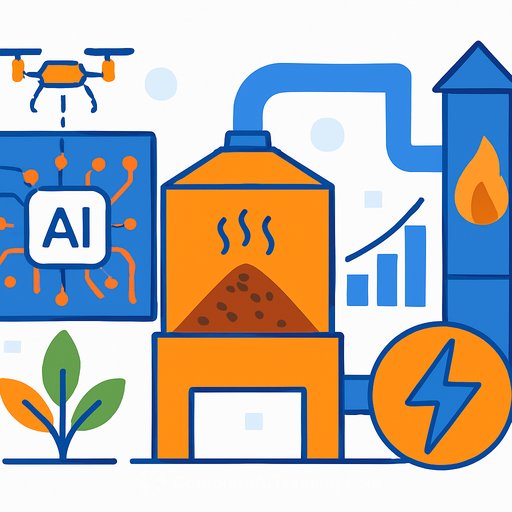
The focus: drying biomass feedstocks like agricultural waste and forestry residues. This single step can consume more than 70% of pre-processing energy before those materials become fuels or bioproducts. If you reduce the energy burn here, the whole value chain gets cheaper and easier to scale.
The technical approach
The team will pair physics-informed machine learning with INL's experimental research and ongoing AI Research to optimize how moisture moves through plant materials. Expect models that learn from both real data and first-principles physics to predict drying behavior and suggest process changes that cut energy use.
They'll also test methods that reuse waste heat-including heat from nuclear plants-to drive drying more efficiently. The combination of smart heat sourcing and predictive control is aimed at lowering costs and improving throughput without expensive trial-and-error.
The research group at Mines, Process Optimization, Design Integration and Informatics (led by Khoda), will build high-fidelity models to evaluate drying strategies before anything gets installed. That saves time, capital, and rework.
"Collaborating with INL allows us to merge world-class experimental science with our expertise in physics-informed AI," Khoda said. "This collaboration strengthens South Dakota Mines' role in national clean-energy research and demonstrates how trustworthy, high-fidelity AI can accelerate discovery in bioprocessing, materials and energy systems."
The project also supports student training and workforce development through hands-on work in clean-energy R&D, data science, and advanced manufacturing-efforts that align with the AI Learning Path for Training & Development Managers. INL research scientist Nepu Saha serves as the project's principal investigator.
Why this matters for IT and development teams
- Physics-informed ML: Fuse domain equations with data to cut sample needs and improve generalization in edge cases. Think PINNs and hybrid surrogates that remain stable under changing process conditions.
- Digital validation before build: Use simulators to test dryer designs, heat sources, and control policies virtually. Reduce CapEx risk and compress iteration cycles.
- OT + ML integration: Expect sensor fusion (temperature, humidity, airflow), feedback control, and online learning loops built for industrial constraints and safety.
- Deployment reality: Likely split workloads between on-prem/edge for low-latency control and cloud for training and scenario planning. Prioritize reproducible pipelines, versioned datasets, and clear rollback paths.
- Track useful KPIs: kWh per kg of water removed, $/ton processed, throughput stability, downtime, and emissions impact. The goal is material energy reduction from the current >70% pre-processing share.
- Governance: Traceable models, physics-aware guardrails, and clear operating envelopes are essential-especially with heat sourced from nuclear facilities.
What to watch
- Validation data: How models perform across different biomass types, particle sizes, initial moisture, and ambient conditions.
- Waste-heat integration: Interfaces to heat recovery systems and the reliability of supply across operating schedules.
- Production handoff: MLOps maturity, fail-safe controls, and the ability to keep models current as equipment and feedstock change.
Learn more
For background on the institutions and domain:
Level up your AI skill set
If you build ML for industrial processes and want practical upskilling, explore focused training paths such as the AI Learning Path for Process Engineers.
Your membership also unlocks: