Bionic Facial Robot Research Makes Science Robotics Cover, Achieves Precise AI-Driven Lip Synchronization
Published: January 15, 2026
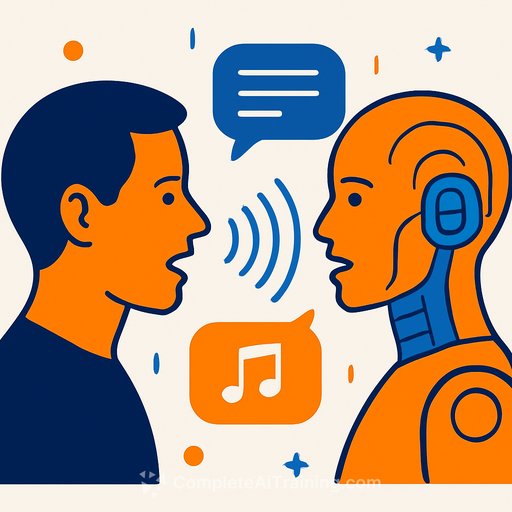
A humanoid robot with a biomimetic face has hit the cover of Science Robotics for demonstrating precise, natural lip movements synchronized with speech and singing. The study comes out of Columbia University's School of Engineering, led by Chinese scientist Dr. Hu Yuhang, and shows a practical route to lifelike facial control using self-supervised learning.
The robot's face is covered in flexible silicone skin and driven by more than 20 miniature motors. That hardware gives the system enough degrees of freedom to mimic human lip shapes without looking stiff or delayed.
How the system learns
The core idea is a self-supervised "vision-to-action" loop: the robot observes itself in a mirror and learns how visual lip shapes map to motor commands. This builds a facial motion transformer that can autonomously control lip movements to match audio-essentially, robot self-modeling without labor-intensive labels.
- Mirror-based self-observation removes the need for manual annotation.
- The facial motion transformer converts desired lip shapes into precise actuator sequences.
- The approach scales to speech and singing, where timing and articulation vary quickly.
What testing showed
Experiments reported smooth, accurate lip sync across English, Chinese, and Spanish, plus complex musical rhythms. The results suggest strong cross-lingual generalization rather than narrow, dataset-specific tuning.
Some phonemes still push the limits-especially those requiring full closure or pronounced rounding like "B" and "W." The team notes the system continues to improve as it gathers more experience, which is expected for self-supervised control.
Why this matters for HRI
Natural facial expression-starting with lips-is a missing capability in most humanoids. As robots move into emotionally driven use cases such as education and companionship, believable expression becomes a baseline requirement, not a nice-to-have.
By grounding control in self-observation, this work offers a practical path to reducing the uncanny valley and making interactions feel more human. It also points to a general recipe: let robots build their own internal models of how to move, then align those models with audio and context.
Practical notes for researchers
- Data strategy: self-supervised mirror capture cuts labeling overhead and supports continuous improvement.
- Control stack: prioritize actuator bandwidth, latency, and repeatability to maintain audio-motion sync.
- Evaluation: test across languages and singing to stress timing, coarticulation, and articulation extremes.
- Hardware-skin interaction: account for silicone compliance and friction; calibration drift matters over time.
- Edge cases: plosives and rounded vowels need tighter closure control and possibly predictive timing.
What's next
Extending beyond lips to cheeks, jaw, and eye regions could further stabilize perceived naturalness. Multimodal cues-prosody, gaze, and contextual intent-will likely close the gap in social interaction quality.
For source material and institutional context, see Science Robotics and Columbia Engineering.
If you're building skills in self-supervised learning and robotics control, you may find curated AI research resources useful: Research.
Your membership also unlocks: