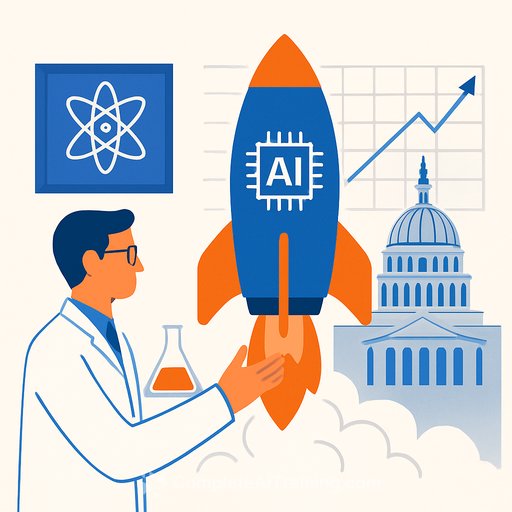
Mission Genesis: A Federal Push to Accelerate AI Research and Deployment
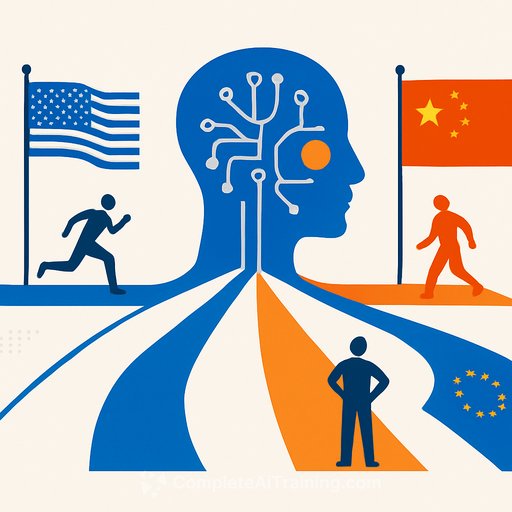
According to a White House release dated November 24, President Donald Trump signed an executive order establishing "Mission Genesis," a federal initiative to expand compute capacity, open access to federal science data, and speed the path from discovery to deployment. The intent is straightforward: accelerate scientific breakthroughs, strengthen national security, lift productivity, and improve returns on public research investments.
The effort will be led by Michael Kratsios, Assistant to the President for Science and Technology and Director of the Office of Science and Technology Policy. In both scope and urgency, the plan is likened to the Manhattan Project-ambitious, centralized, and geared for outcomes.
What the order sets in motion
- Scaled compute and data access for researchers working on high-impact problems.
- Faster translation of models and methods into field-tested solutions.
- Creation of the "American Platform for Science and Security," a joint hub for compute, tools, and large data sets.
- Coordination across agencies and with private partners to reduce duplication and speed execution.
American Platform for Science and Security
The Secretary of Energy is directed to establish a shared platform that provides researchers with the compute, tools, and data needed to train and evaluate AI models. The near-term focus is practical: automate parts of the research workflow and compress cycle times from hypothesis to result.
Within 90 days, the Department of Energy must identify available systems and data-government and private-that can support the program. Expect an inventory of HPC clusters, trusted data repositories, and priority queues for teams working on national priorities.
Implementation timeline and focus areas
Within 270 days, AI is expected to be applied to critically important tasks in advanced manufacturing, robotics, biotechnology, and nuclear research. The emphasis will be on projects with measurable milestones, clear validation criteria, and obvious downstream impact.
How this lands for researchers
- Prepare to request compute and storage through new queues tied to national missions. Have clear resource plans and job profiles ready.
- Organize data now: documentation, provenance, licensing, and security controls. Well-governed datasets will move first.
- Target proposals to the named domains (manufacturing, robotics, biotech, nuclear) and highlight time-to-impact.
- Build for reproducibility: containerized workflows, versioned datasets, and standardized benchmarks.
- Address dual-use and safety in your design docs. Expect reviews to probe misuse risks and mitigation.
- Line up partners at national labs and universities to access specialized instruments and domain expertise.
NAIRR context
Mission Genesis builds on the National AI Research Resource (NAIRR), established to provide a shared national infrastructure for AI research. If you've worked with the NAIRR Pilot or tracked its calls, the new program signals larger scale and tighter links to deployment.
Background resources: the National AI Initiative site outlines ongoing federal programs and coordination mechanisms. See AI.gov. For context on the NAIRR Pilot, visit nairrpilot.org.
Expert perspective
Policy analysts, including Kagan McBride of the Center for a New American Security, highlight AI's potential to transform how research gets done-especially by automating routine methods, exploring larger design spaces, and iterating faster. The opportunity is to shift more time from setup to discovery while keeping guardrails tight.
Risks and guardrails to plan for
- Security: stronger controls on model weights, sensitive data, and access logs-especially for bio and nuclear contexts.
- Validation: independent replication, stress testing, and evaluation against public baselines.
- Efficiency: prioritize model and pipeline efficiency to reduce cost, queue time, and environmental impact.
- Compliance: align with export controls, privacy laws, and agency-specific requirements from day one.
Timeline recap
- First 90 days: DOE inventories compute and data assets, including private-sector contributions.
- By 270 days: AI applied to priority domains with concrete projects and early results.
Action steps for your lab this week
- Audit your data assets and finalize data management plans, including access tiers and consent coverage.
- Package your core pipelines in containers and set up CI for benchmark runs.
- Draft a 2-page concept note mapping your work to manufacturing, robotics, biotech, or nuclear objectives.
- Identify a national lab or industry partner and outline a shared test plan with success metrics.
- Prepare a risk assessment section covering dual-use, safety, and red-teaming.
If you're refreshing skills for large-scale experiments or proposal work, you can scan curated AI courses by research role here: Complete AI Training - Courses by Job.
Your membership also unlocks: