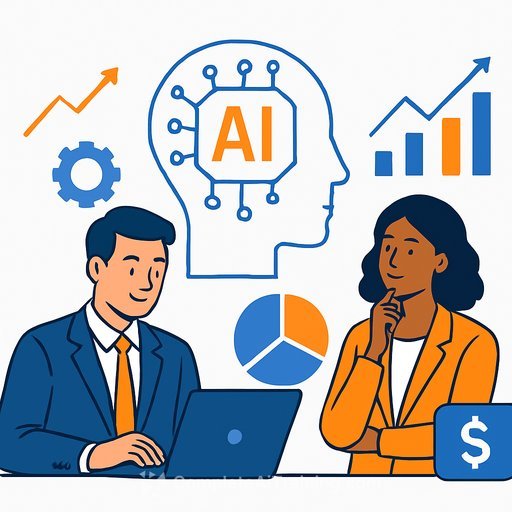
AI Can Already Do 11.7% of U.S. Work. Here's What Finance Teams Should Do Next
A new MIT-ORNL "Iceberg Index" estimates AI can replace $1.2 trillion in wages, or 11.7% of the U.S. workforce. The tool looked at 151 million workers, 32,000 skills, and 923 occupations to see which skills AI can handle today.
It doesn't forecast when or where jobs will be lost. It simply shows where AI is capable right now-especially in document-heavy work and routine analysis that finance teams run every day.
Key Findings That Matter for Finance
- Exposure is skill-based, not title-based. If tasks are document-processing or pattern recognition, they're in scope.
- Entry-level coding demand is already shifting as AI generates huge volumes of usable code. Expect a similar pattern in finance ops and reporting.
- In finance, AI speeds documentation and routine analysis. Roles evolve rather than disappear when oversight and decision-making remain human.
- States like North Carolina, Utah, and Tennessee have started simulations to prioritize training and infrastructure for the workforce.
Finance Workflows Most Exposed Right Now
- Document processing: loan packages, onboarding files, K-1s, 10-K/10-Q sections, policy docs, meeting notes.
- Routine analysis: variance checks, exception reviews, expense categorization, covenant monitoring, cash-flow tagging, simple forecasting.
- Communication: drafting memos, summarizing earnings calls, board-pack preparation, client updates.
- Controls support: reconciliation drafts, audit prep outlines, issue triage-always with human review.
What's Unlikely to Be Replaced (For Now)
- Judgment calls: edge-case credit decisions, materiality assessments, audit sampling strategy.
- Relationship work: investor conversations, client advisory, negotiations.
- Accountability: sign-offs, regulatory attestations, final ownership of financial statements.
90-Day Action Plan for Finance Leaders
- Map exposure by role. Break tasks into: automate (AI-ready), assist (AI drafts, human final), retain (human-only).
- Pick 2-3 pilots with baselines. Target 20-40% cycle-time cuts on one reporting or documentation process.
- Stand up oversight. Human-in-the-loop review, prompt libraries, versioning, and source logging.
- Tighten data guardrails. PII handling, retention rules, vendor access controls, and SOC 2/ISO evidence collection.
- Refresh job descriptions. Emphasize data literacy, prompt competency, tool supervision, and judgment.
- Train the team. Start with prompt workflows for documents and analysis, then BI/Excel integrations.
Use Cases to Pilot
- Close process: flux analysis drafts, footnote summaries, tie-out checklists.
- FP&A: rolling forecast narratives, driver-based scenario notes, variance write-ups.
- IR/Exec comms: earnings summaries, Q&A prep, board-pack highlights.
- Compliance: policy comparisons, control evidence summaries, audit request lists.
Metrics That Matter
- Cycle time per process and per document.
- Error rate vs. baseline (pre- and post-AI).
- Hours saved per month and cost per task.
- Escalation count and turnaround for AI mistakes.
Questions to Ask Vendors
- Data handling: training sources, isolation, storage location, and retention.
- Audit trail: can we export prompts, outputs, reviewers, and timestamps?
- Controls: how do you mitigate hallucinations and support SOX/SEC/FINRA obligations?
- Reliability: fallback paths when models fail or drift; human override options.
Skills to Build This Quarter
- Prompting for financial documents and analysis (summaries, reconciliations, variance narratives).
- Spreadsheet/BI integrations with LLMs for faster analysis and reporting.
- Reg-tech basics for AI: record-keeping, disclosure rules, and approval workflows.
Need a starting point? See vetted AI tools for finance teams here: AI Tools for Finance.
Bottom Line
AI is already competent at a meaningful slice of finance work, especially documents and routine analysis. That doesn't mean headcount vanishes-it means task mix shifts, oversight tightens, and output per person climbs.
States are running scenarios. Finance leaders can do the same inside their orgs: start small, measure hard, keep people in the loop, and scale what proves safe and useful.
Your membership also unlocks: