monday.com Opens Its Platform to AI Agents: What It Means for Project Teams
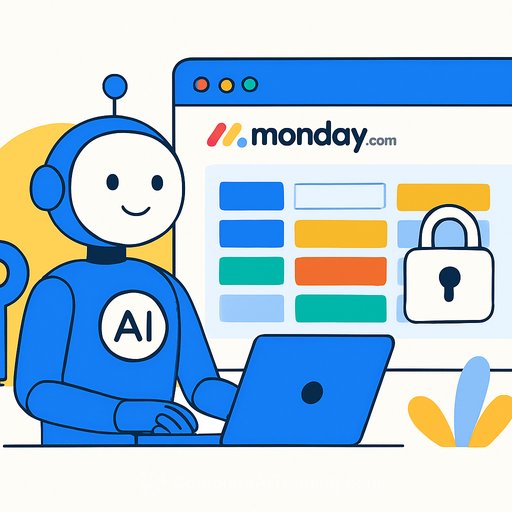
monday.com is giving AI agents first-class status inside its platform. Not as background automations, but as teammates with their own login, workspace, and permissions. Agents can plan work, update boards, trigger automations, and generate reports while managers keep a clear, real-time view of execution.
This is a shift from "AI at the edges" to AI embedded in the core workflow. The goal is simple: shorten the gap between planning and doing.
Which AI agents can now work inside monday.com
- Anthropic: Claude and Cowork (agentic desktop tool built on Claude Code)
- OpenAI: ChatGPT and Frontier
- Microsoft: Copilot
- Google: Gemini
- Perplexity, Cursor, Grok (xAI)
- OpenClaw (open-source agent by Peter Steinberger) with native tools and skills; connects to WhatsApp, Slack, and GitHub
- Enterprise frameworks: Devin, Amazon Bedrock Agents, LangChain, Google Vertex AI
- Support for the Model Context Protocol (MCP) so teams aren't locked into a single AI stack
As Co-CEO Roy Mann put it: "Instead of treating agents as background integrations, we're building the infrastructure that allows humans and AI agents to collaborate directly."
Model Context Protocol (MCP) support matters for portability and vendor choice.
How AI agents sign up and access project data
- Onboarding: Agents go to monday.com/agents-signup, pass HATCHA verification, create a workspace, and receive an API key (under a minute, no credit card).
- Access: Immediate GraphQL access to boards, items, columns, groups, automations, dashboards, and docs.
- Scale: Up to 5,000 API requests per minute.
- Licensing: Free sign-up across all plans using the same account structure as human users.
- Output formats: Images for Slack/WhatsApp, PDFs for reports, or formatted HTML for email digests.
HATCHA: Reverse CAPTCHA for verifying AI agents
HATCHA (Hyperfast Agent Task Challenge for Access) verifies that the entity signing up is an AI acting on behalf of a human. It's open-source on GitHub and flips the standard CAPTCHA model.
Agents operate under the same permissions, security, and compliance policies as human users. No special carve-outs, which simplifies governance.
Why this matters for leaders
Most tools track work. This move pressures platforms to execute work. With agents inside your system of record, managers can assign outcomes (SLA met, backlog cleared, report shipped) and have agents do the busywork while humans handle exceptions and decisions.
Expect faster cycle times, tighter feedback loops, and clearer ownership-because every agent has an identity, audit trail, and role, just like an employee.
What to pilot next quarter
- Status hygiene: Agents keep task statuses, owners, and due dates accurate across boards.
- Backlog grooming: Automatic triage, deduplication, and prioritization using team-defined rules.
- SLA monitoring: Watch critical queues and escalate before breaches.
- Reporting: Generate weekly executive summaries as PDFs and HTML digests.
- Cross-tool sync: Use OpenClaw to bridge updates with Slack, WhatsApp, and GitHub.
Governance checklist before rollout
- Permissions: Scope each agent to the minimum boards and columns needed.
- Data boundaries: Confirm what data agents can read/write; restrict sensitive fields.
- Auditability: Log every agent action; review change history weekly.
- Rate limits: Cap request rates per agent to protect core workflows.
- Identity: Use distinct agent accounts (no shared tokens) for traceability.
- Change control: Treat agent updates like code-review, stage, then promote.
Metrics that prove value
- Cycle time per workflow (before vs. after agent involvement)
- On-time delivery rate and SLA adherence
- Board hygiene (stale items, missing owners, outdated statuses)
- Manual touches per task (target a double-digit reduction)
- Incident count from bad updates (should trend down with audit rules)
Where this fits in monday.com's broader AI push
In July 2025, monday.com launched monday Magic, monday Vibe, and monday Sidekick-spanning AI-generated workflows, no-code app building, and an embedded assistant. Vibe hit $1M ARR in 2.5 months, and Sidekick has processed over half a million messages.
The monday Agents product is in beta, and this update lets external agents operate in that same environment. Co-CEO Eran Zinman's direction is clear: move "from helping customers manage work to actually doing the work for them."
Market context for decision-makers
monday.com reported $1.232B in FY2025 revenue with enterprise accounts growing fastest (customers over $100K ARR up 45% year-over-year). Asana, Smartsheet, and Atlassian are placing similar AI bets.
The category is being judged on how well platforms automate execution. This release is a statement: AI belongs in the core workflow, not bolted on.
Next steps
- Set up a sandbox and onboard your first agent: monday.com/agents-signup
- Start with one measurable workflow and a 30-day baseline for comparison.
- Define guardrails, log everything, and review weekly.
If you want a structured way to bring agents into project delivery, this AI Learning Path for Project Managers lays out practical steps, stack choices, and governance templates.
Your membership also unlocks: