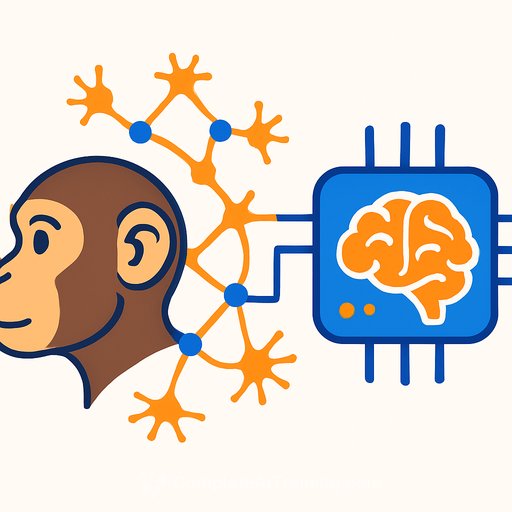
Pocket-sized AI "brain," guided by monkey neurons
Biological brains sip energy. Most AI systems chug it. A new model reported in Nature shows how far we can push efficiency without sacrificing much performance: 60 million parameters compressed to 10,000, with accuracy that stays close to the original.
The team built a compact model of the visual system's V4 area using macaque data, then removed redundancy and used photo-compression-style statistics to shrink it. The result is small enough to share in an email-and simple enough to inspect neuron by neuron.
Why this matters for researchers
- Efficiency at the edge: If vision models can run on tiny footprints, more sensing and perception can move off the data center and onto devices.
- Interpretability without a microscope: Fewer parameters make neuron selectivity easier to study, enabling mechanistic hypotheses you can actually test.
- Biology as a blueprint: If compact, brain-inspired models match or beat larger networks on key tasks, we have a clearer direction for both neuroscience and AI engineering.
What the model captures from V4
V4 neurons are tuned to mid-level features: colors, textures, curves, and "proto-objects." In the compressed model, some artificial neurons lit up on shapes with strong edges and lots of curvature-think arranged fruit with repeating curves and smooth gradients.
Other neurons keyed in on small, dot-like features. That aligns with a primate bias for detecting eyes and eye-like patterns. Specialization like this helps explain how brains achieve strong performance with minimal compute.
How they got from 60,000,000 to 10,000
The group trained on macaque visual data, isolating the V4 stage, then trimmed what didn't add signal. They hunted down redundant components and used image-compression-inspired statistics to encode what mattered most.
The key move: keep representational diversity while discarding "nice to have" redundancy. That balance preserved task performance and made the model small enough to move around as a tiny file.
Limits the team didn't gloss over
Compression alone won't fix core gaps between today's AI and human vision. Humans recognize a face across scenes, angles, lighting, and haircuts with ease; current systems still stumble here, even with serious compute.
That suggests our network designs may still reflect older brain theories. Updating architectures to match modern neuroscience could matter as much as (or more than) shrinking parameter counts.
Implications you can act on
- Test compact baselines: Add a compression-first model to your benchmarks. Track accuracy, latency, and energy on the same datasets you use for larger nets.
- Probe selectivity early: Run feature visualization and controlled stimuli to map neuron preferences (curves, textures, dots). Smaller models make these analyses faster and clearer.
- Design for invariance: Stress-test viewpoint, lighting, occlusion, and appearance shifts. If performance drops, add augmentation and targeted curricula before scaling up parameters.
- Right-size your hardware: Evaluate whether embedded GPUs/NPUs can now meet your latency targets. For some applications (e.g., on-device perception), big servers may not be necessary.
- Quantify redundancy: Before training yet another giant model, measure overlap in features and activations. If redundancy is high, a compression pass could be your fastest win.
Where this could show up first
Any perception workload where power, thermals, or cost are tight: lab instruments, field sensors, mobile microscopy, and robotics. Even in autonomous driving, better selectivity could help separate "pedestrian" from "plastic bag" on leaner compute stacks.
In research settings, compact, inspectable models are ideal for hypothesis testing. You can iterate on circuit-level ideas-then scale only when the mechanism is solid.
Open questions worth pursuing
- Can we train compact models directly, instead of compressing after the fact, without losing performance?
- How well do V4-like features transfer across domains (medical imaging, satellite, materials microscopy)?
- What modern neuro findings (beyond 20th-century views) should be "baked in" to network design to improve invariance?
Bottom line
Brains do more with less by leaning on specialized, efficient representations. This work shows that when we mirror that strategy-prune redundancy, preserve the right features, and keep models inspectable-we get closer to biological performance without the compute bill.
Further reading: See the report in Nature for the peer-reviewed details. If you're building AI into research workflows, explore resources under AI for Science & Research.
Your membership also unlocks: