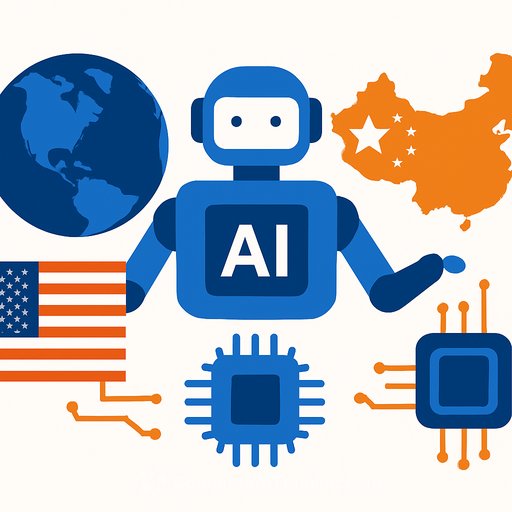
Kimi K2.5 tightens the US-China AI gap: what engineers should pay attention to
Moonshot AI's new model, Kimi K2.5, scored only a few points behind the latest systems from OpenAI, Anthropic, and Google DeepMind in third-party evaluations. That puts China closer to the US lead than at any prior point, and it's raising uncomfortable questions about how effective US export controls on advanced chips really are.
"It seems that, for these Chinese start-ups, it was just a matter of getting access to capital," said Kyle Chan of the Brookings Institution. "I wouldn't have guessed that Chinese AI companies would continue to keep pace with their US peers as recently as a month or two ago."
Moonshot, founded in March 2023, was valued at US$4.3 billion after a US$500 million Series C in December. Backers include IDG Capital, Tencent, and Alibaba Group.
Benchmark signal: open weights, near-frontier performance
Artificial Analysis placed Kimi K2.5 just behind the US leaders in its comprehensive benchmarking. The model's weights are public and downloadable (595 GB), allowing teams with adequate hardware to self-host and customize instead of paying subscription fees.
That open-weights approach puts pressure on closed APIs. As Chan put it, when an open model is "basically just as good," subscription-first business models have to compete on more than raw model capability.
Cost profile and architecture
Artificial Analysis estimates Kimi K2.5 runs at over four times lower cost than top US models. Moonshot attributes this to a Mixture-of-Experts (MoE) design, echoing a broader shift toward sparse activation for better throughput per dollar. US compute constraints have forced Chinese teams to squeeze more efficiency from their stacks.
If you want a refresher on MoE, the original sparse routing work and follow-ons like Switch Transformers are useful context: Switch Transformers (arXiv).
Multimodal and "agent swarm" features
Kimi K2.5 is Moonshot's first multimodal release with support for images and video alongside text. Artificial Analysis called this the removal of a "critical barrier" for open models, as several Chinese peers still lack full multimodal inputs.
The headline feature for builders is "agent swarm" - up to 100 subagents executing in parallel. This is squarely aimed at software workflows that decompose into concurrent steps, like code generation, review, testing, and deployment checks. The trade-off: parallelism lifts computational load and spend.
We're already seeing the limits. Zhipu AI recently restricted parallel use of its coding product due to compute pressure. Moonshot has limited agent swarm access to premium tiers for the same reason.
US controls: performance vs. capacity
Lennart Heim, an AI policy and semiconductor expert, notes that export controls are biting in capacity and availability, even if they haven't dented single-model performance. In short: China is executing a fast follower strategy, but with friction where large-scale, always-on capacity is required.
For broader policy context, see the China Center at Brookings: Brookings - John L. Thornton China Center.
What this means for engineers and product teams
- Evaluate open weights seriously: 595 GB means planning for storage, IO, and checkpoint management. Budget for sharding and quantization if supported.
- Use MoE-aware inference stacks: pick runtimes that handle expert routing efficiently and exploit tensor/TPU/GPU parallelism without fragmentation.
- Run the TCO math: Artificial Analysis pegs K2.5 inference at over 4x cheaper than leaders, but include infra, scaling, observability, and ops in your model.
- Exploit multimodal where it pays: unify OCR, vision, and text workflows to cut tool sprawl and latency. Keep prompt and context interfaces consistent across modalities.
- Orchestrate agents with guardrails: cap parallel subagents, meter token budgets, and fail fast on dead branches. Parallel speedups vanish if retries spiral.
- Expect feature gating: premium-only access to high-parallelism features is likely until compute availability improves.
Bottom line
Kimi K2.5 shows that open-weight, MoE-driven models can sit near the frontier on quality while undercutting costs. If your org can shoulder the hosting, the build-vs-buy equation just moved again - especially for Coding-focused, workflow-driven use cases.
Want hands-on upskilling?
For engineers moving into LLM apps, agents, and MoE-era inference, see the coding-focused track here: AI Certification for Coding. You can also browse role-based options: Courses by Job.
Your membership also unlocks: