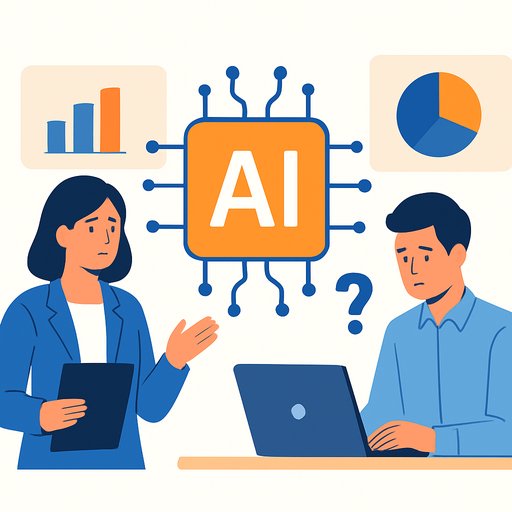
72% of Companies Use AI, But Half Lack Training to Deploy It
Most organizations have adopted AI tools. Few have equipped their workforce to use them effectively. That gap between adoption and capability is now the central challenge for executives planning 2025 strategy.
According to an Express Employment Professionals-Harris Poll, 72% of U.S. hiring managers said their company uses AI in 2025, up from 66% in 2024. But 55% of those same managers said their organization lacks training or resources to help employees use AI effectively.
The problem isn't disinterest. AI tools evolve faster than most organizations can adapt their people and processes. The conversation has shifted from what AI can do to how humans collaborate with it day-to-day-and how to do that securely.
Three Core Skills Matter Now
AI adoption has moved beyond specialists. Salespeople, educators, and healthcare professionals now use AI regularly. This shift requires a different training focus than earlier, more technical approaches.
Organizations should develop three foundational skills across their workforce:
- Prompt engineering and natural language interaction. As AI becomes embedded in operating systems and applications, employees need to communicate clearly with these tools.
- Data literacy. Users must recognize bias, question outputs, and make decisions without needing to be data scientists.
- Security and privacy awareness. Employees should understand how AI models-both local and hybrid-handle sensitive information.
A recent AI PC Report found 95% of respondents agree training is essential for AI use. Yet skills alone won't close the gap. Employees need tools designed to support how they actually work.
The Real Risk: Unsanctioned Tools
Gusto research found that when employees lack approved AI tools, more than half find alternatives and use them anyway. This creates security risks, fragmented efforts, and frustration for leadership.
Healthcare adoption illustrates the trend. The American Medical Association found that 66% of physicians used healthcare AI in 2024, up from 38% in 2023. They used it for documentation, billing, medical charting, and diagnosis support.
Higher education shows similar momentum. A 2024 Ellucian survey of over 330 U.S. and Canadian institutions found 93% of faculty and administrators expected to expand AI use within two years.
AI Investment Is Now Core Strategy
Organizations have moved past treating AI as discretionary spending. Lenovo's 2026 CIO Playbook found 96% of organizations plan to increase AI investments next year, with average growth rates of 13%.
This isn't about replacing human skills. It's about augmenting them. As AI agents become more capable, the skills challenge shifts from learning to operate tools to learning how to guide, validate, and collaborate with intelligent systems.
What Executives Should Prioritize
Three capabilities will matter most in 2026:
- Workflow redesign skills. Employees should stitch together AI tools and automation to create more efficient, customized processes.
- Digital judgment. Users need to critically evaluate AI outputs and apply human oversight where it matters.
- Change management and AI advocacy. Cultural adoption must keep pace with technical progress.
Success requires treating AI capability as an organizational competency, not an individual tool. Executives should combine skills development with intelligent, personalized systems designed around how people actually work.
The companies that close this gap will gain a competitive advantage. Those that don't will watch their workforce adopt AI on its own terms-with all the security and governance risks that brings.
Learn more about Prompt Engineering and explore how AI for Executives & Strategy can help your organization build the right capabilities.
Your membership also unlocks: