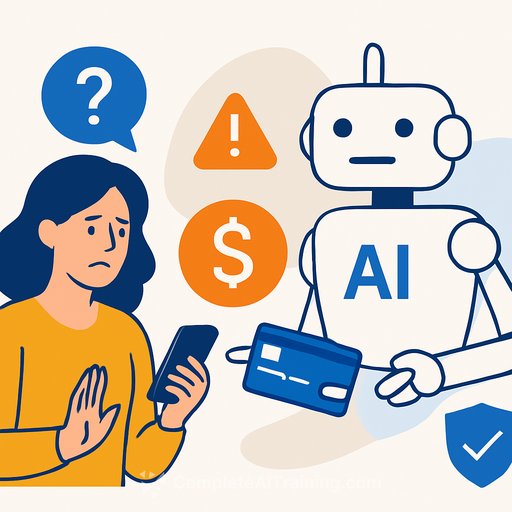
44% of Consumers Expect AI to Handle Payments Within a Decade
A significant gap exists between what consumers think AI will do and what they're comfortable with today. While 44% of U.S. consumers believe AI agents will manage their everyday payments within the next decade, only 32% are currently comfortable letting AI select payment options, according to a survey by Aevi, a Germany-based payments platform.
The disconnect points to a trust problem, not a technology problem. When consumers lack visibility into how AI makes decisions or feel they've lost control over the payment moment, acceptance drops sharply. Fifty-nine percent of surveyed consumers fear losing control over how or when payments are made if AI manages them.
Mike Camerling, Aevi's chief executive, said the issue centers on transparency. "Agentic commerce isn't being rejected because it uses AI. It's being rejected because it removes visibility, perceived control, and a clear moment of consent from payments."
Where Comfort Exists
Consumers show more willingness to delegate specific, limited tasks. Fifty-eight percent were comfortable with AI comparing prices, and 55% accepted AI applying discounts. Only 38% were comfortable with AI completing a purchase without intervention.
The survey included 3,000 consumers across the United States and United Kingdom. U.S. consumers showed higher conditional acceptance-24% gave balanced responses suggesting they'd accept AI payment management under certain conditions, compared to 14% of U.K. consumers.
Business Readiness Outpaces Consumer Comfort
Companies are moving faster than consumers. Visa's separate survey found that 53% of U.S. business executives would allow AI agents to negotiate prices or terms directly with other AI agents. Eighty-eight percent were willing to share pricing or inventory data with enterprise AI agents and automation systems.
This business-to-AI commerce model represents an emerging economic shift. Visa surveyed 2,000 U.S. adults and 512 business executives for its findings.
The Control Question
The surveys reveal a nuanced picture. Fifty-one percent of Americans said they wouldn't feel comfortable with an organization using AI to manage money on their behalf. Yet that same population acknowledges AI will likely handle payments in the future.
The difference lies in consent and understanding. When people see what's happening and why, trust builds. When AI operates invisibly or continuously without clear approval, trust erodes. For managers overseeing digital transformation, this distinction matters: the technology isn't the barrier. The implementation approach is.
Organizations preparing for AI for finance and payment automation should prioritize transparency mechanisms alongside capability development.
Your membership also unlocks: