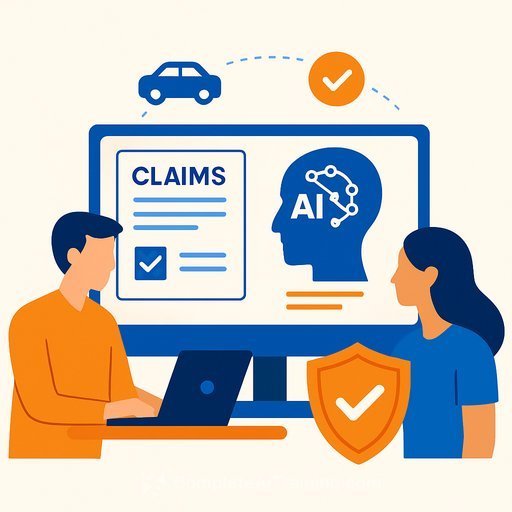
Most Insurers Use AI, but Few Scale It Beyond Experiments
Between 58% and 82% of insurance carriers use AI tools in their operations, but only 12% say they have fully mature capabilities and just 7% have achieved scalable success, according to a new report from Sedgwick on property claims technology.
The finding reveals a gap between industry enthusiasm and practical deployment. Carriers are adopting AI at vastly different speeds, with some still experimenting while others attempt to scale across entire operations.
Fragmentation Limits Results
Nearly two-thirds of carriers report a gap between their AI vision and reality. Different tools and vendors support different parts of the claims process, leaving data inconsistent, incomplete, or siloed across systems.
This fragmentation weakens AI outputs. "With so many tools involved in the claims process, carriers' data is often inconsistent, incomplete, or siloed across systems, which weakens AI outputs and decisions," the report states.
David Guaragna, managing director of Sedgwick Property Americas, attributes the uneven adoption to structural differences across insurance lines. Auto claims require different estimating platforms than property claims. Carriers rely on different partners and systems, so they naturally move at different speeds.
Where AI Is Working
AI handles routine tasks effectively. Eighty-two percent of carriers use AI for data extraction and automated customer interactions. Intake automation has reduced average claim processing times from 10 days to 36 hours for some carriers.
Low-severity claims show the biggest gains. Some carriers report 80% faster processing times for these claims using AI.
Travelers launched an AI claim assistant that takes auto damage claims calls, using OpenAI model capabilities and advanced speech recognition. The service filed initial claims for customers calling about vehicle damage.
Adjusters Still Required
Seventy-five percent of claims professionals say AI needs human oversight. Guaragna agrees that people remain essential for all but the simplest claims.
"AI will enable adjusters to be more efficient," Guaragna said. "But we will need the human touch, especially in claims where you'll always need that empathy with policyholders."
Claims professionals use AI tools like scrubbing platforms to flag cases that require human judgment. These systems analyze information and route complex claims to adjusters rather than attempting automated decisions.
Tim Parker, a claims consultant working with Google's Gemini AI platform, sees information retrieval as a primary use case. Claims professionals ask AI about reconstruction costs, carrier payment limits, and other standard property damage questions.
For more complex losses, some insurers now send contractors to review AI-generated estimates before sending them through approval programs, rather than dispatching adjusters.
Learn more about AI for Insurance and AI Agents & Automation to understand how these tools fit into claims operations.
Your membership also unlocks: