Mount Sinai deploys AI-powered medical search across seven hospitals
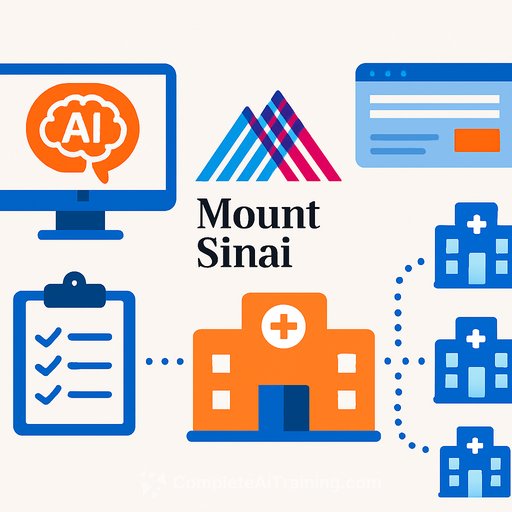
Mount Sinai Health System will integrate OpenEvidence, an AI platform for clinical decision support, directly into the Epic electronic health records used by its seven hospitals. Pharmacists, nurses, and physicians will access the tool within their existing workflow, eliminating the need to switch between applications to find answers.
The deployment marks Mount Sinai's first enterprise-wide AI rollout across multiple clinical roles. Care team members can ask medical questions in natural language and receive answers sourced from peer-reviewed literature and clinical guidelines.
Why this matters for clinicians
The integration addresses a practical problem: information overload. Clinicians spend time toggling between systems to find current evidence. By embedding the search capability directly into Epic, Mount Sinai reduces the cognitive burden of information retrieval.
Nicholas Gavin, Mount Sinai's vice president and chief clinical innovation officer, said the system prioritizes "innovation that solves core clinical problems and scales across the entire delivery system."
Dr. Girish Nadkarni, the health system's chief AI officer, emphasized that the tool needed to be "clinically meaningful" - grounded in rigorous sources rather than generic AI outputs. "This collaboration reflects our broader vision to responsibly scale AI across the health system in a way that enhances clinical decision-making, reduces cognitive burden and ultimately improves outcomes for our patients," he said.
Other health systems moving in the same direction
Sutter Health in California announced a similar integration earlier this year, embedding OpenEvidence into doctors' Epic workflows. Dr. Ashley Beecy, Sutter Health's chief AI officer, said that "patients benefit when providers have the most current and relevant evidence incorporated into clinical decision-making."
Microsoft has also expanded its clinical AI offerings. The company added features to Dragon Copilot to surface clinical insights at the point of care and automate documentation tasks for nurses and other staff.
OpenEvidence added clinical trial matching to its platform in February, helping care teams identify medically appropriate trials filtered by study design, enrollment status, and geographic location.
What Mount Sinai is saying
Daniel Nadler, OpenEvidence's CEO and founder, called the agreement significant because it expands access to the entire care team. "This is the first to expand access to the entire care team, including all Mount Sinai nurses and pharmacists. This is the new baseline for what a modern hospital looks like," he said.
For more on AI for Healthcare and how Generative AI and LLM systems are being deployed in clinical settings, explore our resource library.
Your membership also unlocks: