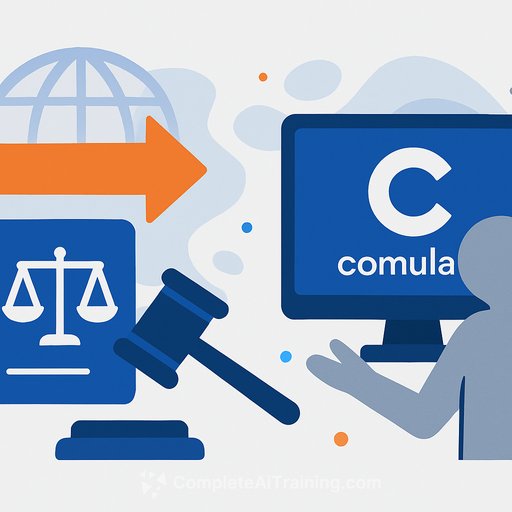
Why An Insurance Software Goliath Is Crushing An AI David
AI promised to level the field. In insurance back-office software, it's doing the opposite.
Applied Systems, a billion-dollar incumbent, and Comulate, a fast-growing AI startup, are locked in a legal fight that should make every agency leader rethink platform risk, vendor access, and data governance. This isn't about hype. It's about who controls the pipes your team uses every day.
The short version
- Applied Systems alleges Comulate misappropriated IP by creating a fake brokerage (PBC Consulting) to get an Epic account and speed product development.
- Comulate says Applied breached a pilot agreement, blocked SDK access, and tried to buy the company; after refusing, Comulate claims Applied moved to shut it out and bad-mouth it to mutual customers.
- Both cases are before U.S. District Judge Manish S. Shah and headed to discovery. Applied has told customers Comulate's Epic access will end by late June (while still allowing usage for now).
What actually happened
Comulate, founded in 2022, built AI-driven automation for insurance accounting and quickly hit eight-figure revenue with support from well-known venture firms. Customers praised the time savings-one user reportedly had "tears of joy."
The hurdle: Epic, Applied's agency management platform that, by Comulate's count, runs core workflows at 81% of large agencies and brokers. Comulate says it needed deep integration to serve those customers.
Applied alleges Comulate created a fictitious customer, Phoenix Benefits Consulting (PBC), complete with a website, a fake agent persona, and a paid account on Epic, to gain product insight and accelerate integration. Comulate acknowledges creating PBC, but claims it did so only after Applied refused to provide promised sandbox access under a signed pilot agreement. Both sides accuse the other of deception and anti-competitive behavior.
Why this matters to agencies and brokerages
- Platform dependence is a single point of failure. If your tools ride on Epic (or any core AMS), vendor access decisions can ripple straight into your operations.
- AI integrations don't just improve workflows-they create legal, data, and change-management exposure if access is cut or terms shift.
- Procurement needs to include rules of the road: SDK rights, sandbox availability, rate limits, data boundaries, and off-boarding expectations.
- Even if courts sort this out, you need practical contingencies before June.
If you rely on Comulate via Epic, do this now
- Request written confirmation from Applied and Comulate about current access, the June cutoff, and any interim changes that could affect billing, reconciliation, or reporting.
- Get a clear, dated contingency plan from both vendors: export paths, data schemas, and manual fallback procedures.
- Schedule a no-surprises meeting between your CFO/controller, operations lead, and IT. Map every workflow that touches Epic + Comulate: imports, exports, automations, and schedules.
- Run a tabletop exercise: simulate Epic access being revoked for Comulate. How do you invoice, reconcile, and report that week?
- Back up configurations and logs. Confirm you can re-create automations elsewhere if needed.
- Freeze non-essential process changes until you've tested the fallback plan.
Procurement and governance improvements (for your next integration)
- Contract for the boring parts: guaranteed sandbox access, SDK/API versioning, and minimum notice for deprecations or suspensions.
- Define data boundaries. Who touches what, where it's stored, how it's logged, and how you can wipe it on exit.
- Insist on an off-ramp: standardized exports, runbooks, and support for migration.
- Add a vendor "kill-switch" runbook: who does what in week 1 if access disappears.
- Review your insurance coverage (tech E&O, cyber) with this exact scenario in mind.
- Maintain optionality: a second integration, middleware, or manual process you can activate within 72 hours.
The bigger context: AI is colliding with control
AI agents and code-assist tools lower the cost to build software, which pressures incumbents and tempts startups to move faster than gatekeepers allow. Incumbents are racing to bolt AI onto their suites and keep customers close. Upstarts want to plug into the systems where work already happens.
That collision creates gray zones-access, fair use, and speed. Expect more disputes like this as AI workflows push against platform policies. For reference on AI agent development trends, see Anthropic and the AI Agents & Automation tag for practical examples of agent-driven automation in operations.
What to watch next
- Any motion that changes near-term access (e.g., injunctions) before discovery ramps up.
- Whether Applied extends, shortens, or sticks to the June cutoff.
- Signals from other AMS vendors on SDK access and partner rules.
- Customer comms: if you're a joint customer, push for plain-English updates with dates and specific operational impacts.
Resources
- Case status and procedures: U.S. District Court, Northern District of Illinois
- Upskill your team on practical AI for operations and controls: AI for Operations
- Executive guidance on implementing AI and governance: AI Learning Path for Vice Presidents of Operations
Bottom line: if you build on someone else's platform, play by their rules-or have a plan for when access disappears. Do the paperwork up front, and keep an exit door unlocked.
Your membership also unlocks: