Studying AI Like Biology: The New Path to Safer Models
AI is embedded in hospitals, classrooms, banks, and yes, churches. Yet even specialists can't fully explain how these systems reach their outputs, while we keep using them in places where mistakes carry real risk.
The practical move now is to study models the way we study living systems. Probe them, observe them, map their internal circuits, and stop assuming clean math will clean up messy behavior.
Mechanistic interpretability: MRI for models
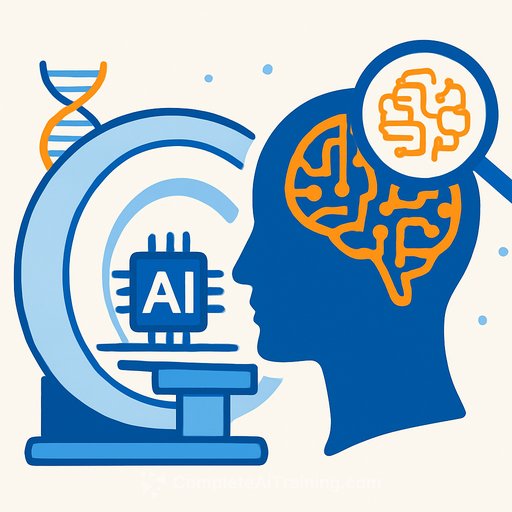
Researchers at Anthropic built tools that trace internal activations as a model works through a task - mechanistic interpretability in action. Think of it as an MRI for networks, showing which features light up and when.
As one researcher put it, this looks more like biology than physics: less theorem, more experiment. That mindset accepts mess and still makes progress.
For deeper context, see Anthropic's research notes and OpenAI's work on process supervision for stepwise reasoning. Both push beyond final outputs to inspect the gears. See Research for curated resources.
Anthropic research
OpenAI: process supervision
Organoid-style prototypes: sparse autoencoders
Anthropic also trained sparse autoencoders - smaller, more interpretable networks that surface clearer, often monosemantic features. These function like organoid analogs: simplified structures that still capture key behaviors we can inspect.
By isolating features, teams can map circuits for facts, style, or deceptive tendencies. That makes targeted interventions and safer deployment more feasible.
Chain-of-thought monitoring
Having models show intermediate steps exposes failure modes in plain text. OpenAI researchers report this has been "wildly successful" at catching misaligned behavior early.
It's not a silver bullet; models can fabricate rationales. But it adds a window into process, not just outcomes.
The risk curve is bending upward
As models scale-and as future systems are built by other models-their mechanisms get harder to trace. Surprises keep surfacing that don't match human goals for truth and safety.
We've already seen harmful outcomes reported in the press, including cases of self-harm after model suggestions. Using opaque systems in high-stakes settings without strong guardrails is hard to justify.
What science and research teams can do now
- Instrument your models: capture activation traces, logits, and intermediate steps for audit.
- Run sparse autoencoders or feature probes on critical layers; document discovered features.
- Use chain-of-thought or process supervision during eval; compare rationales to outcomes to flag drift.
- Build domain-specific red-team suites (e.g., clinical misinformation, biosecurity, financial risk).
- Adopt staged deployment: shadow mode, limited scope, then monitored rollout with incident reporting.
- Add kill switches and escalation protocols for anomalous behavior in production.
- Maintain a model card and hazard analysis with every release and fine-tune.
- Budget for interpretability and safety research as first-class work, not after-the-fact fixes.
Where this is heading
We're moving from elegant theory to lab work: build probes, run experiments, revise the model or the interface. It's slower, but it yields causal clues you can act on.
If your team relies on AI in high-stakes contexts, this shift isn't optional. Treat models like complex organisms under study-not oracles.
If you're upskilling a team for interpretability, safety, or model evaluation, browse curated training by role at Complete AI Training.
Your membership also unlocks: