
AI news ·
Munich court holds Google liable for false AI Overviews claims, making product design a legal liability
A Munich court held Google liable for false AI Overviews, treating the text as company speech. This exposes the 9% error rate across five trillion annual searches.
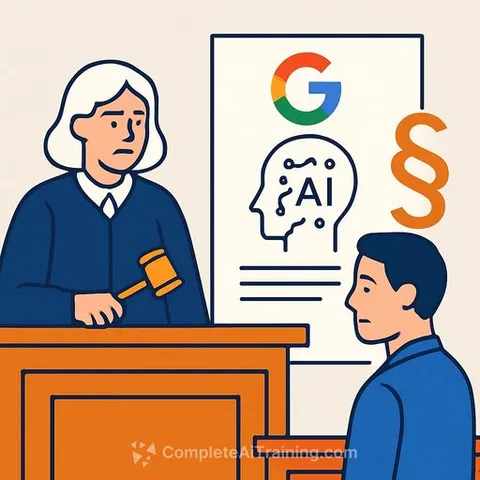
A Munich court issued a preliminary ruling in May 2026 that Google is directly liable for false claims generated by its AI Overviews, according to the court filing. The decision treats AI-generated content as the company's own statements, not search results, and carries substantial legal weight in Germany even while Google appeals.
The ruling hinged on a single distinction: AI Overviews produce answers in their own words, making them the company's speech. The scale of exposure becomes clear when you look at the numbers. Google handles roughly five trillion searches per year. A New York Times study with the AI startup Oumi found AI Overviews answered factual queries correctly 91% of the time in February 2026. That 9% error rate still means tens of millions of wrong answers every hour.
The verifiability problem grew faster than the accuracy improved. In October 2025, 37% of correct answers linked to sources that did not fully support them. By February 2026, that figure reached 56%. Users clicked on cited sources in only 1% of visits when an AI summary appeared, per Pew Research Center. Source design becomes a direct legal exposure, not a UX preference.
Confidence without verification is a design choice
AI Overviews compress the research process into a single authoritative answer, stripping away the competing sources and comparison signals that users once relied on to evaluate credibility. When an answer arrives fully formed and confidently stated, the interface itself implies the work of verification has been done. A cited source and a checkable source are not the same thing.
Doug Hughmanick, Founder of the digital product design studio ANML, said the trust problem stems directly from how AI presents information. "That is a better experience in many ways, but it also removes many of the signals that help people evaluate credibility," he said. "As AI becomes the interface, products need to make trust visible, not assumed."
AI citations carry legal weight
Citations in AI interfaces carry more weight than in traditional search precisely because users click through so rarely. A source badge or link tells users the answer is grounded. When that source does not fully support the claim, the design has already done its damage before anyone reads it. A University of Tennessee and University of Oklahoma study found that persistently visible sources helped users maintain critical evaluation as information volume increased.
"One of the biggest mistakes is presenting every answer with the same level of confidence," Hughmanick added. "AI is probabilistic, but many interfaces make uncertainty look identical to certainty. If a source does not directly support the claim, trust disappears quickly."
Accountability is a design requirement
The German ruling formalized something product teams already face: when an AI system speaks with authority, the company behind it owns what it says. Hughmanick outlined four principles he argues will define trustworthy AI products:
- Every meaningful claim should connect back to its source.
- Confidence should reflect how reliable the information is, including knowing when to say the system does not know.
- Users should always be able to trace how an answer was formed and get back to the source.
- AI responses carry the same accountability as anything else a company ships under its name.
"Users don't distinguish between the model and the brand. They simply remember whether the product earned their trust," he said. Products that retrofit source transparency and confidence design after something goes wrong are correcting what should have been the architecture.
Why this matters for legal professionals
The Munich ruling treats AI-generated statements as company speech, which means the design decisions behind confidence displays, source attribution, and uncertainty handling are now decisions legal teams may be asked to defend. For legal professionals advising clients on AI deployment, the ruling clarifies that AI-generated content carries the same liability as any other corporate statement. Understanding these liabilities is now a core part of AI for Legal training.
Designing for uncertainty and low-confidence answers has long been treated as an edge case. The court record now shows that ignoring it is a liability. Teams that have not mapped these decisions yet have a product gap, regardless of what any court decides. The earlier those decisions get made, the less expensive they are to correct.