Audio AI meets music education: MuseCool's plan to fix practice
Music education hasn't changed much in decades. Weekly lessons, spotty home practice, and teacher intuition instead of data. That loop makes progress slow and retention fragile.
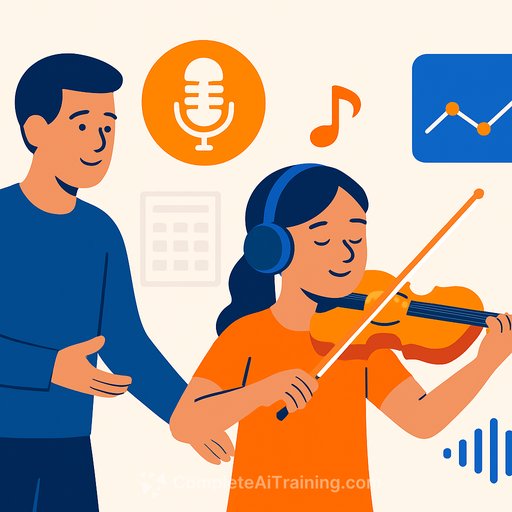
MuseCool, a London-based music school founded in 2017, is building a different system. It blends conservatory-level teaching with audio AI that turns lesson moments into focused, gamified practice for kids aged 5-14. The bet: fix practice, and you fix outcomes for students, parents, and teachers.
From scholarship student to founder
CEO Petru Cotarcea grew up in Romania, where low-cost music education opened a door he couldn't have afforded elsewhere. By 14, he was competing internationally, earning a scholarship to Chetham's School of Music, then training at the Royal Academy of Music. At 18, he played in the West End production of Sweeney Todd - a fast track into professional performance.
After an ill-fated investment in a peppermint farm, he returned to what he knew best: teaching music. Today, he runs one of the largest music schools in London, with operations in the UK and New York - and a product focus on practice, data, and teacher enablement.
The core problem: practice and proof
Most kids don't practise enough. Without steady reps, progress stalls, parents cancel, and teachers can't show what works. As Cotarcea puts it: "Fix practice, and you fix the entire system."
There's also almost no structured data inside lessons. Teachers teach how they were taught. Methods are passed down by lineage, not measurement. Piano dominates beginner demand, yet few programs track what actually improves consistency and confidence week to week.
Why audio AI is tough (and why it matters)
- Audio is continuous and layered, unlike text. Timing, pitch, articulation, and dynamics vary second by second.
- Humans can spot "close enough" timing and tuning; machines struggle with imperfect, real-world performance.
- Off-the-shelf tools are limited. Useful feedback needs custom models, careful training, and real lesson data.
That difficulty is exactly why education needs it. If software can interpret messy, human playing and turn it into precise, bite-sized practice, teachers get leverage and students get momentum.
How MuseCool works
- During lessons, teachers press "start" and "finish." The system "listens," detects what happened musically, and logs it.
- Between lessons, The Muse (their AI practice assistant) generates short, game-like sessions tied to what was just taught.
- Parents see simple practice analytics. Teachers get insights to plan the next session without reinventing the wheel.
Early testing surfaced a surprise: beginner lessons include less actual playing than expected. There's talk, encouragement, attention management - all essential, but invisible without data. Scaling this data could inform better teacher training and curriculum design across programs.
What this means for schools and studios
- Make practice measurable: Track days practiced per week, minutes per session, error reduction, and time-to-piece proficiency.
- Keep teacher agency: Use AI for targeted reps and feedback loops; keep interpretation, expression, and motivation human-led.
- Privacy and consent: Recording lessons requires transparent policies, opt-ins, and clear data retention standards.
- Access and equity: If practice shifts to guided digital sessions, provide devices or school-owned tablets where needed.
- Curriculum fit: Map practice "games" to your syllabus and assessment goals so gains show up in exams and performances.
- Implementation basics: Quiet rooms and a decent mic can boost detection accuracy without major spend.
Two bets: platform + marketplace
MuseCool is building on two layers. First: a global practice platform that tutors can use for free while parents subscribe, so kids practise better and lessons land. Second: a teacher marketplace that matches families with tutors using actual performance data, not just bios.
The company is piloting this inside its London school, with a public launch planned for March and a broader international rollout after.
Metrics to watch (so you know it's working)
- Practice consistency: Days per week and sessions completed.
- Quality: Error rates on rhythm and pitch, tempo stability, and section mastery.
- Progress velocity: Time from first attempt to confident performance of a piece.
- Retention: Month-over-month continuation and re-enrolments.
- Teacher leverage: Prep time saved, clarity of next-step planning, and lesson continuity.
- Parent clarity: Do updates make sense without musical training? Are they acting on them?
Risks and how to handle them
- Misclassification: Set thresholds so kids get encouragement first, precision later. Let teachers override.
- Over-gamification: Tie points to real skills (timing, tone, posture) and cap streak pressure to avoid burnout.
- Teacher pushback: Involve staff in pilot design, share wins fast, and use data to reduce-not add-admin.
Bottom line
Practice is the lever. If audio AI can turn lesson moments into tight, guided reps at home, students stick with it, parents see progress, and teachers spend more time teaching. That's a system worth testing.
If you're updating staff skills around AI and implementation, explore curated options by role here: AI courses by job.
Your membership also unlocks: